 ablut
The eight countries, and where each one starts
Each country in Faith opens with its own numbers and its own weak spot. What you inherit in each, and what to look at first.
· 5 min read
A move that works in one country can sink you in another. The eight countries in Story mode share one economy, but each opens with its own numbers and its own weak spot. Knowing where the danger is on day one saves a run.
The problem: the same moves, different results
Raising the rate calms prices in Alcavera; in a country with almost no reserves, waiting to raise it lets the currency run. Borrowing in dollars is cheap in one country and a trap in another. The difference is what you inherit.
Why: each country opens differently
These are the starting numbers from the country screen:
| Country | Type | Difficulty | Income per person | Rating | Inflation | Unemployment | Debt | FX debt | Reserves |
|---|---|---|---|---|---|---|---|---|---|
| Badrawan | Oil exporter | Medium | $14.0k | AA | 5.0% | 8.0% | 25% | 20% | 70 |
| Kiyoshima | Industrial legacy | Medium | $13.0k | A | 4.0% | 6.5% | 60% | 50% | 40 |
| Koulimba | Agrarian economy | Medium-hard | $3.5k | A | 6.5% | 9.0% | 30% | 25% | 30 |
| Alcavera | Educated and idle | Medium | $8.9k | A | 3.0% | 11.0% | 45% | 25% | 45 |
| Nusaraya | Dollarised economy | Hard | $5.9k | BB | 22.0% | 9.0% | 62% | 55% | 20 |
| Quenalta | Frontier market | Hard | $6.5k | BBB | 7.0% | 8.0% | 58% | 50% | 38 |
| Badaristan | Captured state | Hard | $5.0k | BB | 12.0% | 10.0% | 65% | 35% | 30 |
| Valdavia | Post-conflict | Very hard | $2.5k | B | 18.0% | 13.0% | 75% | 45% | 15 |
Three lines from the other guides explain most of the danger: debt above 70% erodes credibility and adds Palace pressure every month; reserves below 20 make the currency slide on its own; foreign-currency debt above 40% of the total adds to the risk premium.
What to do: country by country
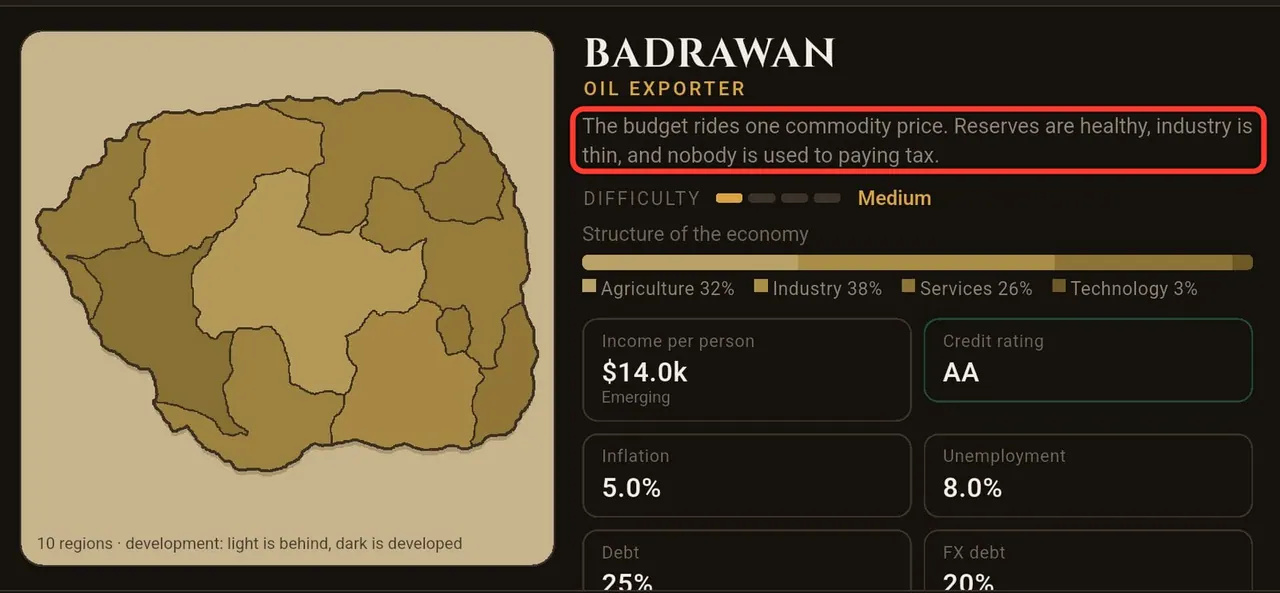
Badrawan. Deep reserves and a current account surplus: the currency is the least of your worries. The weak spot is the budget, which rides one commodity price, in a country where few are used to paying tax. Watch the oil price under WORLD › PRICES. In good years, put money aside and invest beyond oil. Inflation starts above target.
Kiyoshima. Factories and infrastructure are strong. Half the debt is in foreign currency, debt sits at 60% and energy is imported, so a falling currency hits twice: debt swells and the energy bill rises. Keep the currency steady, move new borrowing to Mostly domestic (POLICY › DEBT), and watch the Energy bill line when you tap FX.
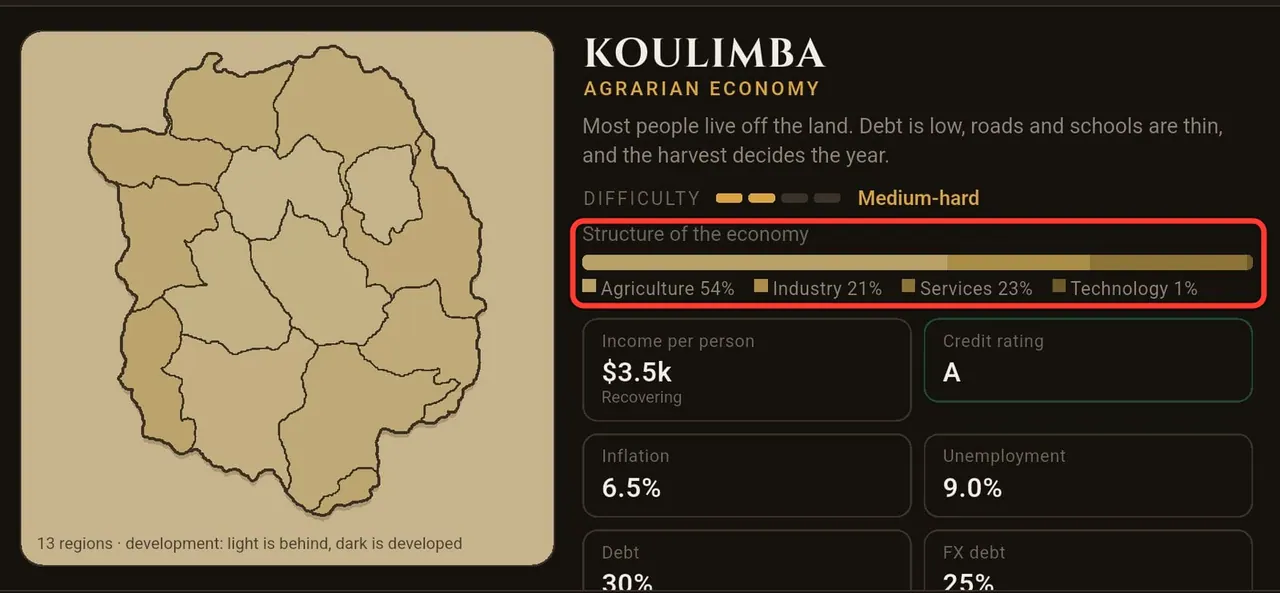
Koulimba. Poor but calm. Debt is low, but human capital is only 16 and the roads are thin; half the economy is farming and the harvest decides the year. It is a long game: keep investment above maintenance, push education and infrastructure, and do not expect income to move much in the first decade.
Alcavera. The game's recommendation for a first run: good schools, plenty of graduates, no jobs. See the guide on your first years.
Nusaraya. Inflation is 22%, half of all savings are in dollars and reserves sit exactly on the 20 line. Above 40% dollarisation, the dollar pushes the currency down by itself and drains reserves, and a slide passes into prices faster. First get the rate above expected inflation and stop printing. FX-protected deposits (POLICY › EXTERNAL) can slow the flight to dollars, but every slide is added to debt. Credibility above 45 stops feeding dollarisation; above 60 it starts refilling reserves.
Quenalta. It grows fast and money is plentiful and nervous. Hot money flows in while your real rate beats the world's and your risk premium is low, and flows out when either turns. Half the debt is in foreign currency and the current account deficit is 3%. Use the good years to build reserves, consider Measured capital movement, and keep the deficit and debt from lifting the risk premium.
Badaristan. Corruption starts at 40, the point where it begins to erode credibility; above 45 it feeds itself, above 70 capital flees. The Palace's network is already strong and its pressure starts at 22. Reform (DEVELOPMENT › GOVERNANCE) is the cure, but it raises Palace pressure every month, so pair it with the tools in the guide on the Palace.
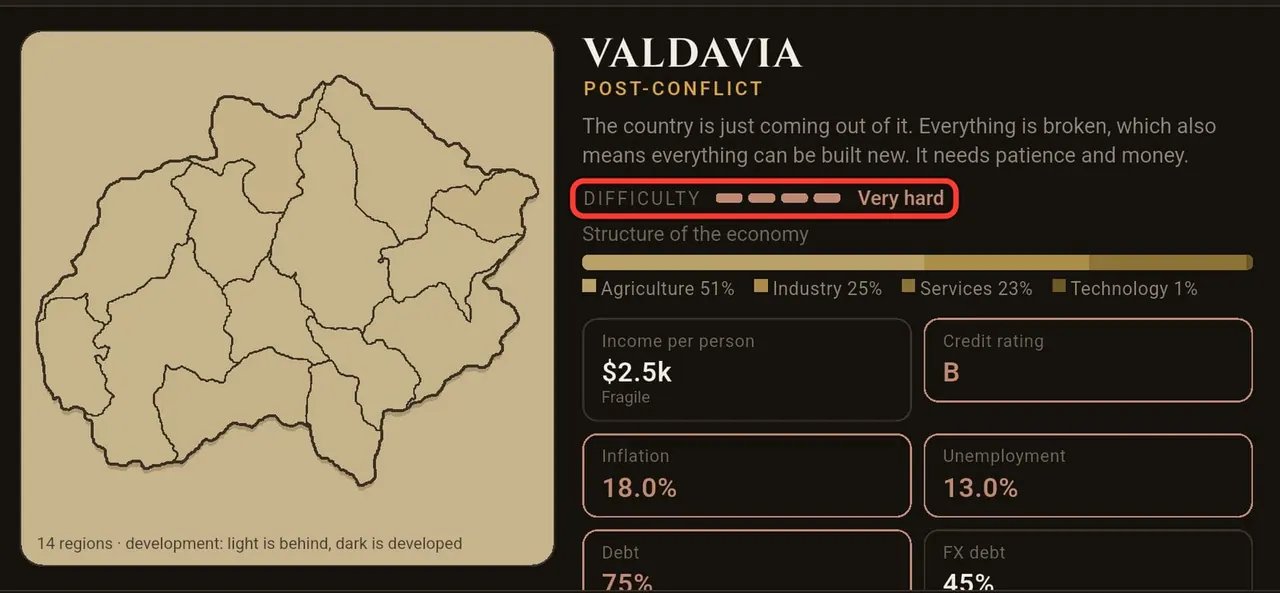
Valdavia. The hardest start: everything is broken. See the example below.
A short example: Valdavia's first month
Reserves start at 15, below the 20 line, so the currency slides from month one. Debt starts at 75%, above the 70% line, so credibility erodes and Palace pressure rises from month one. Inflation is 18% and unemployment 13%.
There is good news too. People are celebrating the peace, and because reserves are below 20, the IMF programme (POLICY › BANKS) is open from the very first month. Taking it early adds 35 to reserves and 10 to credibility, at the cost of spending cuts and some goodwill. That buys the months you need to get the rate above inflation and the budget under control. Valdavia rewards patience: the guide on the currency explains what to fix while the IMF money holds the line.
More guides

Faith: Economy Simulation · 5 min read
Your first years in Faith
Where to look, what to decide and what to leave alone in your first two years, with Alcavera as the example.

Faith: Economy Simulation · 5 min read
Why debt keeps rising, and how to bring it down
The debt ratio has its own momentum. What drives it in Faith, how to read the DEBT tab, and which levers actually work.

Faith: Economy Simulation · 4 min read
Surviving the Palace
The most common way a run in Faith ends is the Palace removing you. Where its pressure comes from, how the ultimatum works, and how to keep it down.

Faith: Economy Simulation · 4 min read
Why the exchange rate jumps, and how to stop a currency crisis
The second most common way a run ends is a currency crisis. What moves the exchange rate in Faith, why reserves matter so much, and which tools buy time and which fix the cause.