 ablut

Why the exchange rate jumps, and how to stop a currency crisis
The second most common way a run ends is a currency crisis. What moves the exchange rate in Faith, why reserves matter so much, and which tools buy time and which fix the cause.
· 4 min read
"My exchange rate went to 230 and I don't know why." After the Palace, a currency crisis is the most common way a run ends. Like Palace pressure, it builds over months, and the game shows every part of it.
The problem: the currency keeps sliding
FX at the top of the screen is the real exchange rate, with 100 as balance. If it reaches 250, that is a currency crisis and your term ends. On the way there, a fast slide feeds into inflation and makes any foreign-currency debt bigger.
Why: four forces and one line
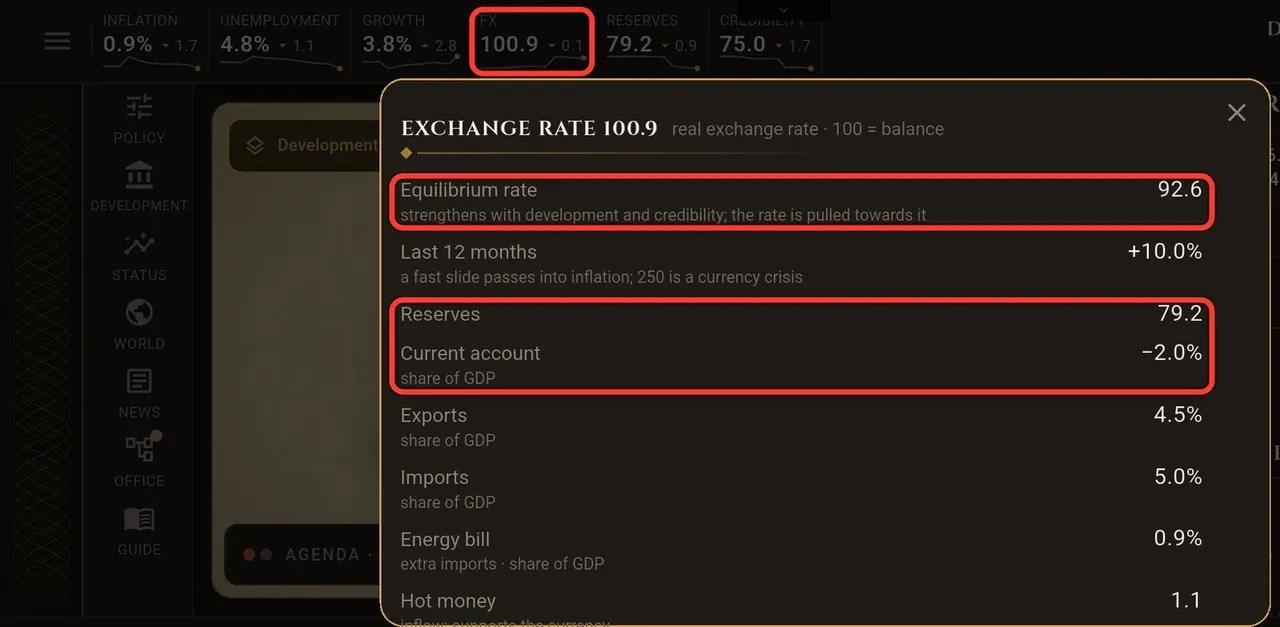
Tap FX and the game shows what moves it. Every month:
- The real interest rate. The currency is roughly neutral when your policy rate is about 2 points above expected inflation. Below that it weakens, above it strengthens.
- The current account. A deficit weakens the currency and drains reserves.
- Printing money weakens it directly.
- The pull of balance. The rate is pulled towards its equilibrium, which strengthens with development and credibility. Higher credibility also makes the pull stronger.
Then there is the line that turns a slide into a crisis: reserves at 20. Reserves grow with a current account surplus. They also grow a little each month while credibility is above 60, and leak away while it is below. Once reserves fall under 20, the exchange rate slides on its own every month, and the further below 20, the faster.
One more accelerator: dollarisation, the share of savings held in foreign currency. It grows when traded goods get expensive fast, when the real rate turns negative, when credibility falls below 45 and when the currency slides. Above 40% it pushes the rate down by itself and drains reserves.
What to do
1. Fix the cause: the rate, printing and the current account
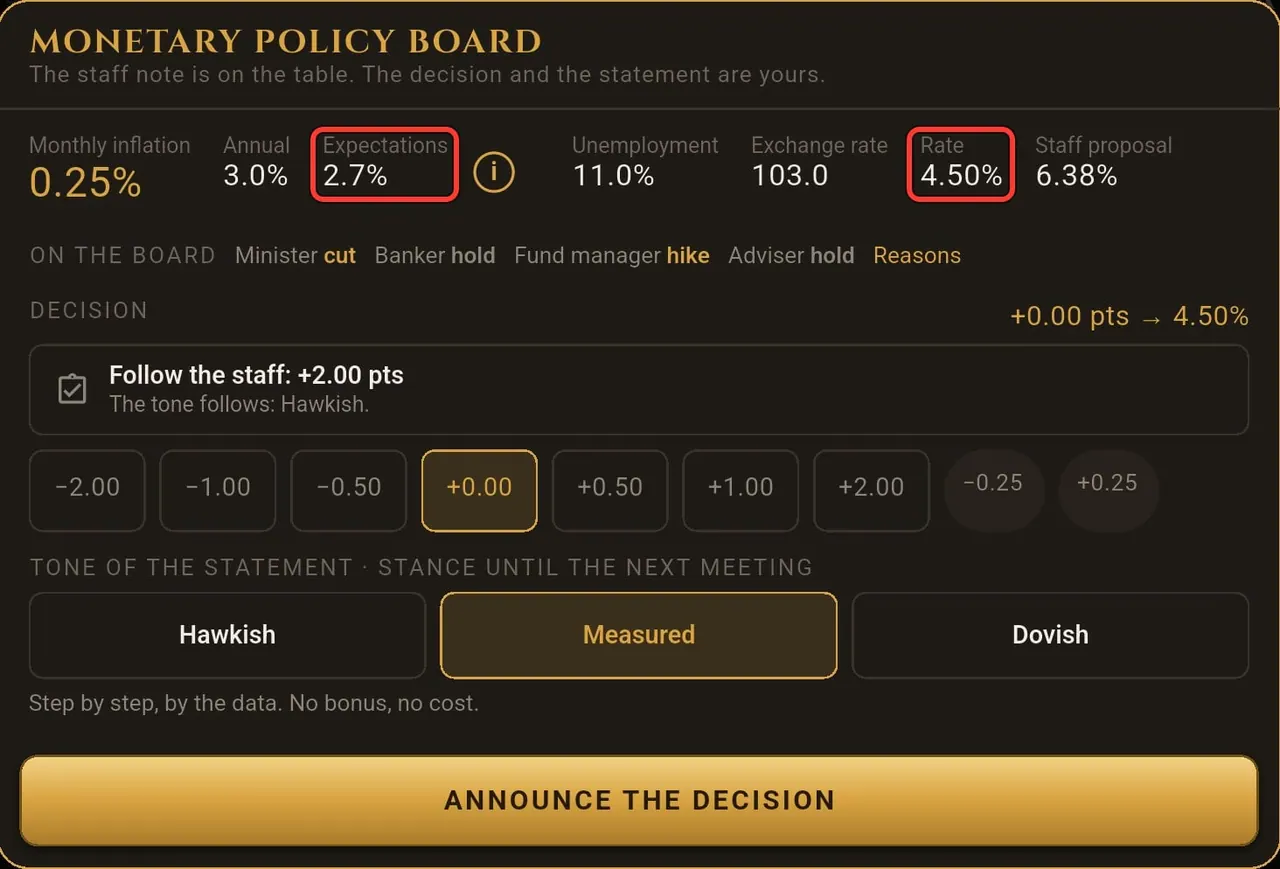
At the board, compare the rate with expected inflation. In Alcavera's first month the rate is 4.50% and expectations are 2.7%, a gap of 1.8 points: just under neutral. When the currency is sliding, keep the rate comfortably more than 2 points above expected inflation. Stop printing money: under POLICY › DEBT, set deficit financing to Market. Shrink the current account deficit: export credit (POLICY › EXTERNAL) and trade deals with partner countries (WORLD, on a country's page) support exports, and so does a currency that is not overvalued.
2. Guard credibility
Credibility above 60 adds to reserves every month and strengthens the pull back to balance. Bringing inflation towards 2% builds it; printing money and saying one thing at the board while doing another cost it. In a hurry, the covert op Foreign backing (OFFICE › OPS) adds 12.
3. Choose the regime with your reserves in mind
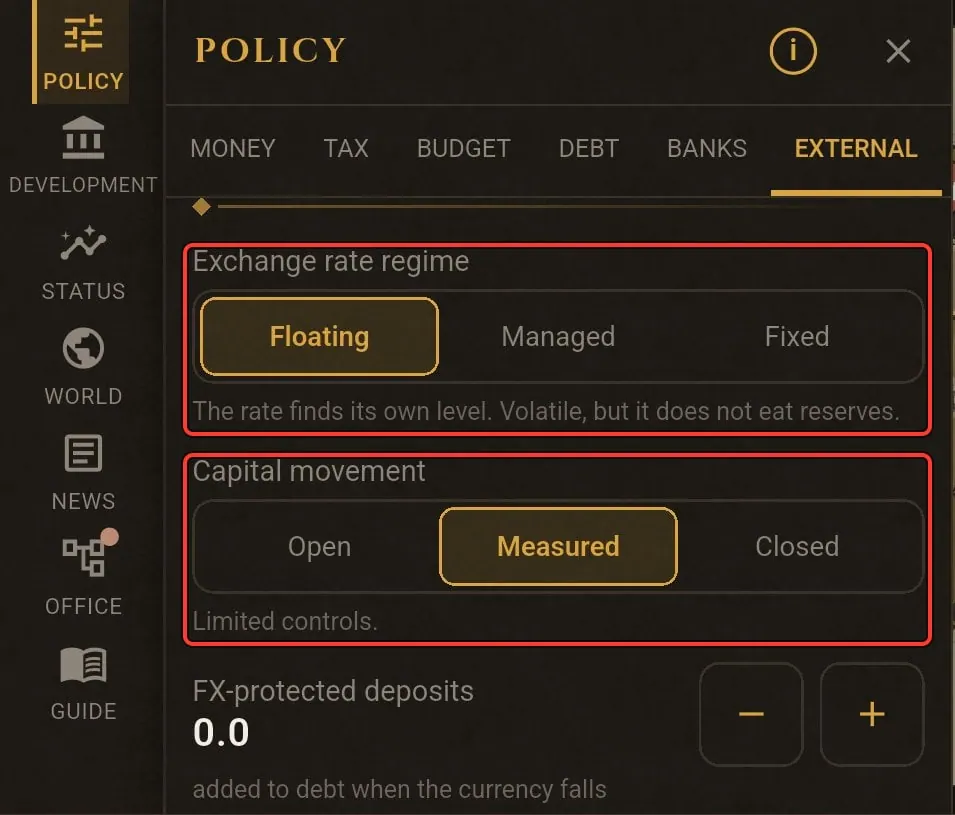
- Floating: the rate finds its own level. It is volatile, but it never eats reserves.
- Managed: reserves absorb about half of each move.
- Fixed: reserves absorb almost all of it and anchor inflation a little. With an open capital account, defending it drains reserves fast. If reserves run out, the peg breaks: the rate jumps, credibility falls by 15 and the regime returns to floating.
Capital movement works the same way. An open account brings investment, but hot money also leaves fast on a bad day. Closing it stops the wave, along with the investment, and costs credibility.
4. Know what only buys time
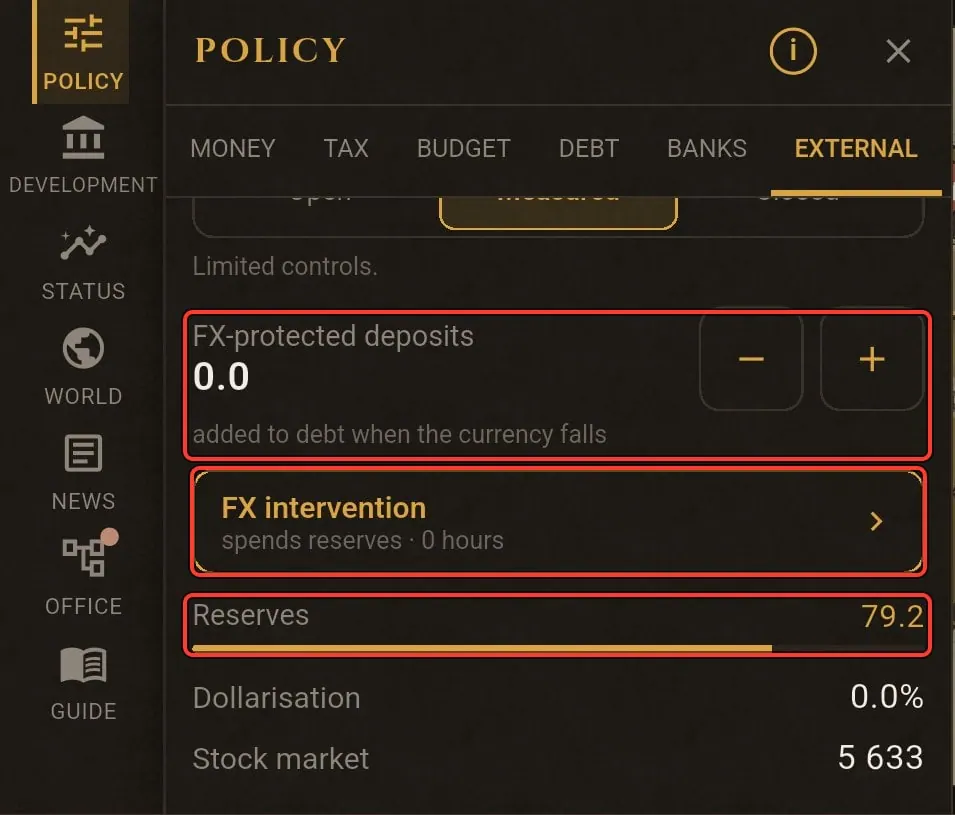
- FX intervention sells reserves and pushes the rate down at once. It does not touch the cause: if the rate, the deficit or credibility are still wrong, the rate comes back and the reserves are gone.
- FX-protected deposits stop savers fleeing into dollars without spending reserves. In calm months they cost nothing; every month the currency slides, the difference is added to public debt.
- The IMF programme (POLICY › BANKS) opens when reserves fall below 20 or debt passes 100%. It adds 35 to reserves and 10 to credibility, at the cost of spending and subsidy cuts, a hit with Parliament and more Palace pressure.
Use these to win months, and spend those months fixing the rate, printing and the current account.
A short example: Alcavera in year 8
In this run's eighth year, FX is 100.9 against an equilibrium of 92.6, so the pull is downward and works in your favour. Reserves are a deep 79.2, so there is no danger yet. The window still shows two warnings: the rate slid 10% over the last 12 months, and the current account is in deficit (−2.0% of GDP). Left alone for years, a deficit like this eats reserves. The time to act is now, while reserves are deep, not when they reach 20.
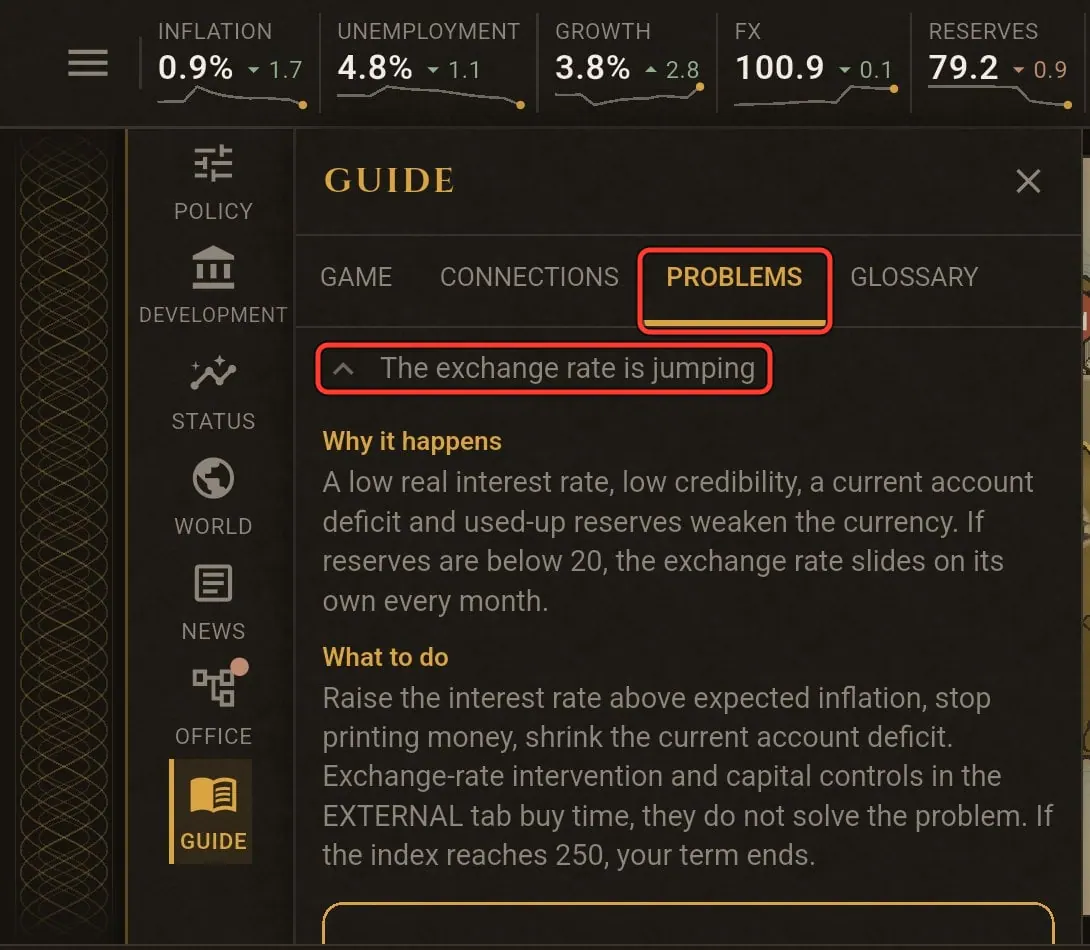
The short version is in the game, under GUIDE › PROBLEMS › "The exchange rate is jumping".
More guides

Faith: Economy Simulation · 5 min read
Your first years in Faith
Where to look, what to decide and what to leave alone in your first two years, with Alcavera as the example.

Faith: Economy Simulation · 5 min read
Why debt keeps rising, and how to bring it down
The debt ratio has its own momentum. What drives it in Faith, how to read the DEBT tab, and which levers actually work.

Faith: Economy Simulation · 4 min read
Surviving the Palace
The most common way a run in Faith ends is the Palace removing you. Where its pressure comes from, how the ultimatum works, and how to keep it down.
Faith: Economy Simulation · 5 min read
The eight countries, and where each one starts
Each country in Faith opens with its own numbers and its own weak spot. What you inherit in each, and what to look at first.