 ablut

Why debt keeps rising, and how to bring it down
The debt ratio has its own momentum. What drives it in Faith, how to read the DEBT tab, and which levers actually work.
· 5 min read
The budget looks fine, yet debt keeps creeping up, and one day the credit rating starts to fall. Debt in Faith follows a single rule, and the DEBT tab (POLICY › DEBT) shows every part of it.
The problem: debt grows by itself
Debt / GDP rises year after year, even when you have not spent more.
Why: the debt ratio has momentum
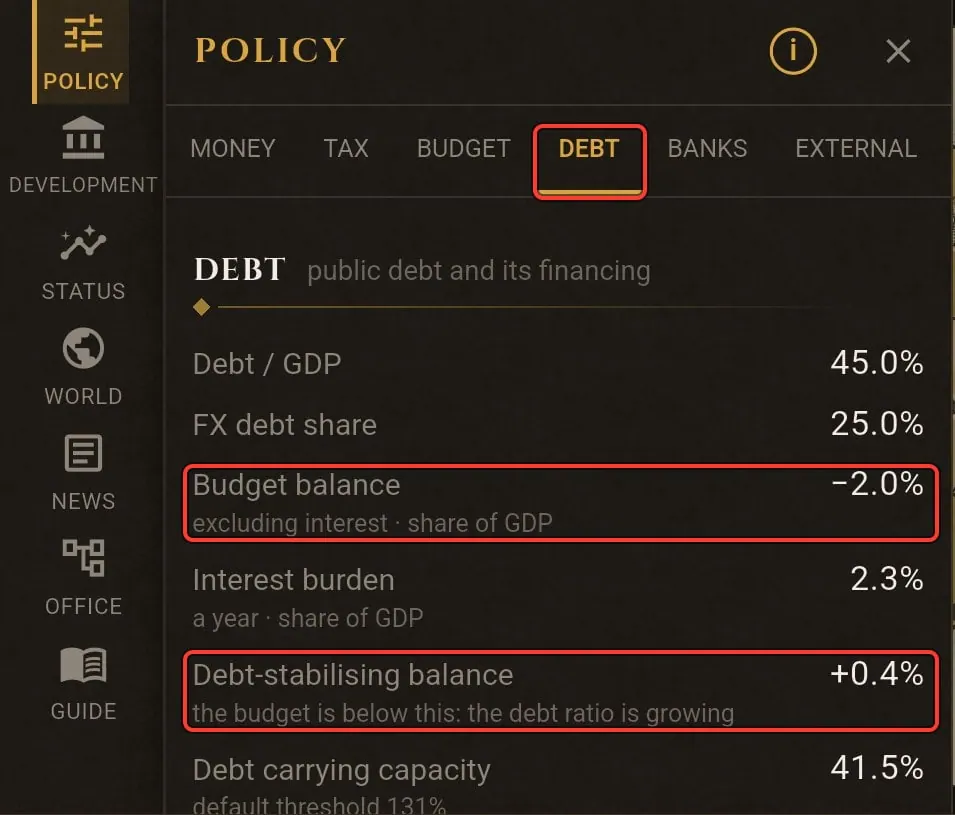
Three things move the ratio every month:
- Interest adds to it. Interest is paid from the treasury, separately from the budget. The "Budget balance" line excludes interest, so a budget that looks balanced can still leave a gap.
- Growth and inflation erode it. Debt is measured against national income. When income grows, the same debt is a smaller share.
- New borrowing fills the gap. When the treasury is at its floor, every missing unit becomes new debt.
When inflation is near zero and growth is low, interest wins: the ratio rises even with a balanced budget. Rich countries grow slowly, so this gets more common as you develop.
The DEBT tab turns all of this into one line, Debt-stabilising balance: the budget balance (before interest) that keeps the ratio where it is. Above it, the ratio falls; below it, the ratio grows. The note under the line tells you which side you are on.
What makes it accelerate
- The risk premium. The market lends comfortably up to the Debt carrying capacity, which starts at 40% of national income and rises with development and with credibility above 60. Every point of debt above it adds to the risk premium. So does a deficit before interest above 3%, credibility below 55, reserves below 25, or foreign-currency debt above 40% of the total. The premium is added to the rate on every new loan, and the rating falls with it. When it passes 6 points (rating B), the market starts to close and part of the deficit is printed whether you choose it or not.
- Debt above 70% of national income erodes credibility every month and adds Palace pressure.
- Foreign-currency debt swells when your currency falls.
- A higher policy rate makes new domestic debt more expensive.
The hard line is the default threshold, shown under the carrying capacity (131% in Alcavera; it rises as the capacity rises). If debt stays above it for three months, your term ends.
What to do
1. Close the gap to the stabilising balance, slowly
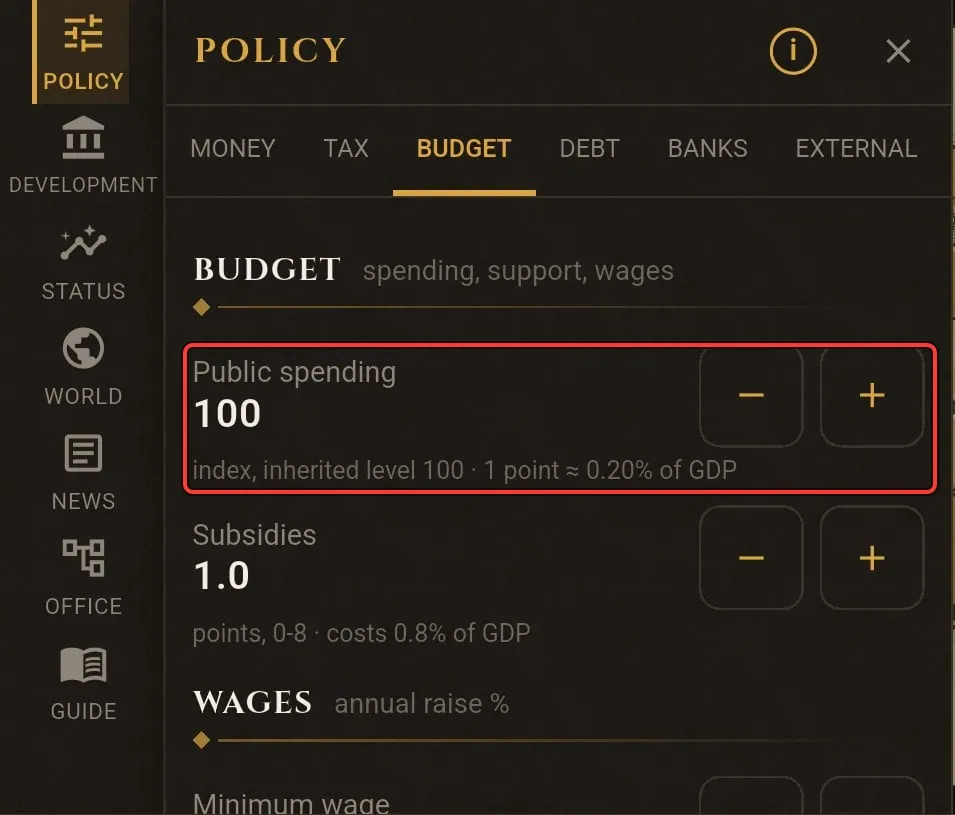
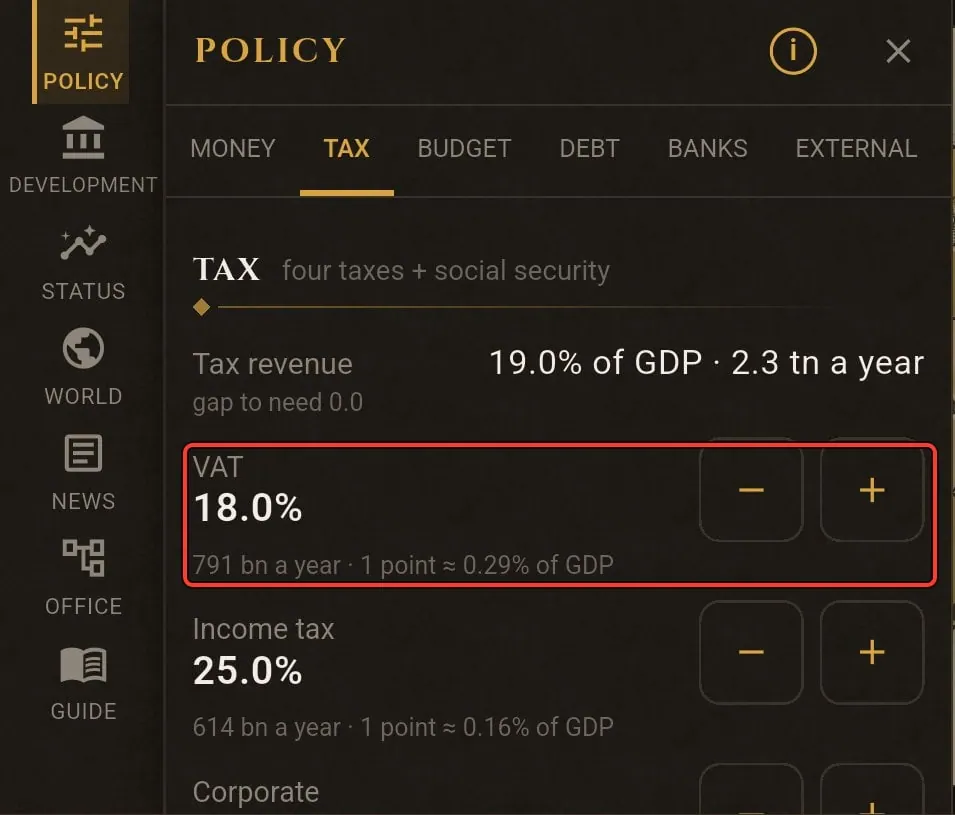
Each lever shows what one point is worth: in Alcavera, a point of public spending is about 0.20% of GDP and a point of VAT about 0.29%. Every option has a cost:
- VAT has the broadest base, but a large increase makes prices jump once and heats up the street.
- A high income tax or social security premium pushes work into the informal economy and takes the revenue back.
- Cutting spending works, but it slows demand for a year or two.
Small steps beat one big shock.
2. Keep inflation at 2%, not zero
A little inflation erodes debt; zero inflation removes that help. Do not keep the rate higher than you need to.
3. Borrow cheaply and long
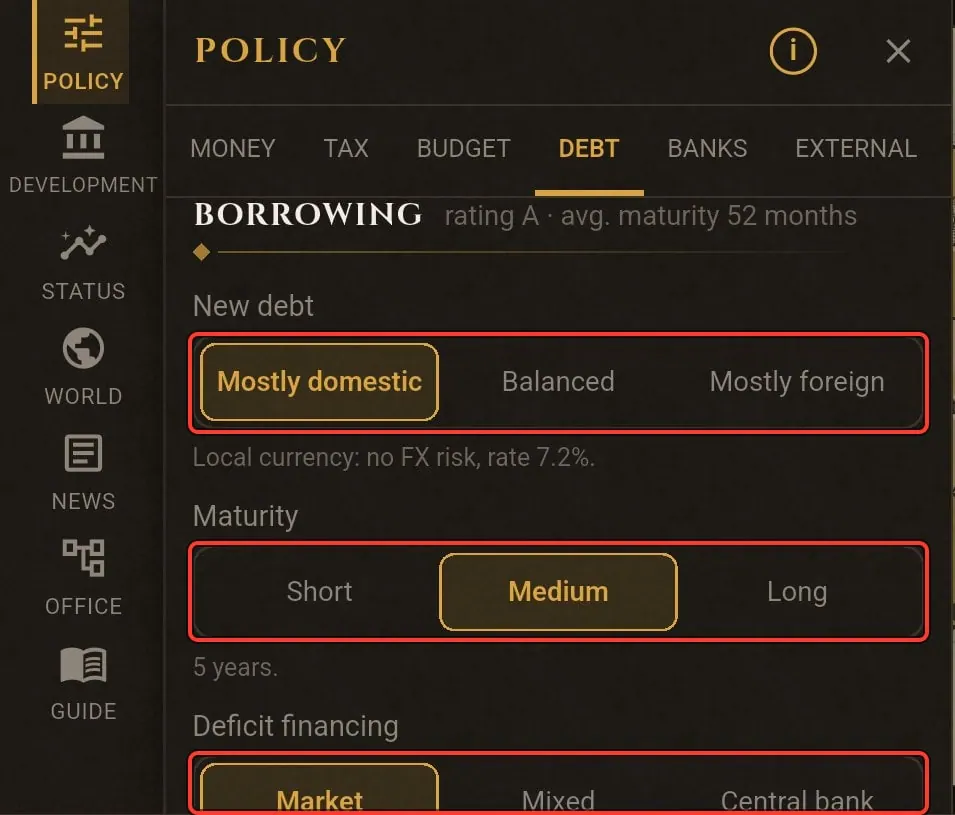
Under BORROWING you set three things:
- New debt: domestic debt carries no currency risk. Foreign debt can look cheaper, but it swells when your currency falls.
- Maturity: short debt is cheap but rolls over often at the market's new rate; long debt locks in today's rate.
- Deficit financing: borrowing raises the interest bill; printing through the central bank stops debt growing but costs inflation, the exchange rate and credibility.
4. Let a surplus work
A surplus goes into the treasury first. Once the treasury is about 4 points above its usual level, a quarter of the excess pays off the most expensive debt every month. Pay down debt from the treasury speeds this up: half of what is above the floor goes to the most expensive debt at once.
5. Know the emergency tools
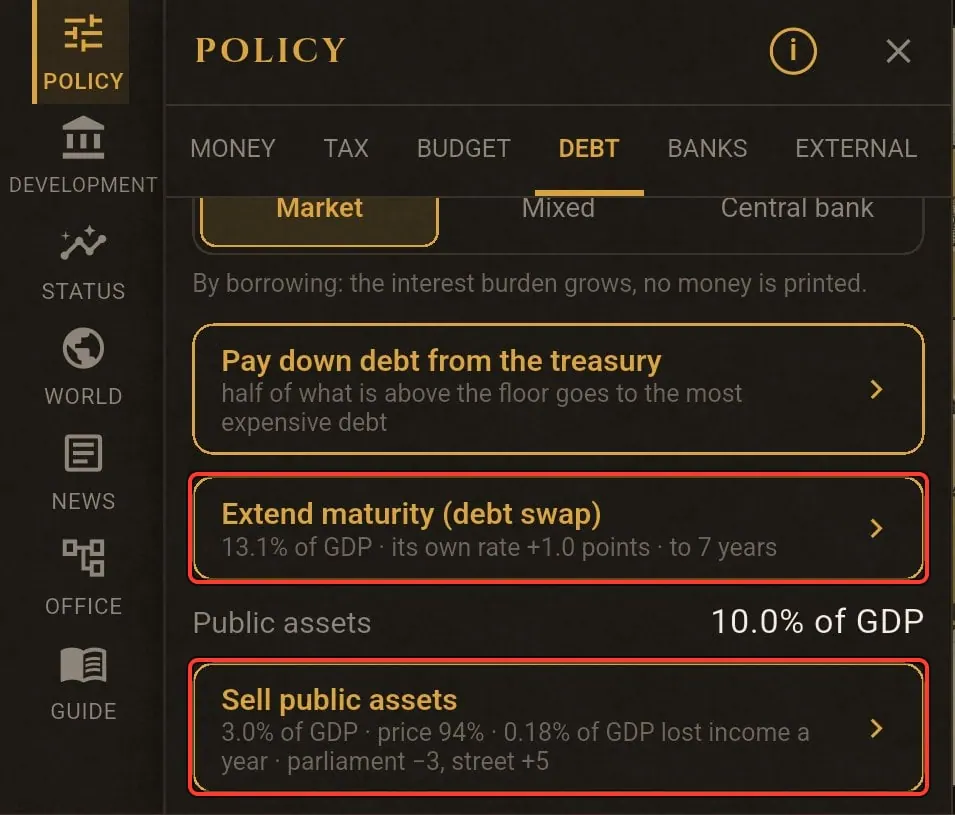
- Extend maturity (debt swap): debt due within two years is pushed out to seven years at its own rate plus a small premium. Once every two years.
- Sell public assets: the cash pays off the most expensive debt, but the assets' income is lost from every future budget. Once a year.
- Restructure the debt: 30% of market debt is written off, at the cost of 15 credibility and four years of market penalty. Only when the rating has fallen to CCC or debt is above 90%, and once a decade.
- IMF programme (POLICY › BANKS): opens when reserves fall below 20 or debt passes 100%.
A short example: Alcavera, year one
At the start, Alcavera's debt is 45% of national income, already above its carrying capacity of 41.5%. The budget balance is −2.0% and the debt-stabilising balance is +0.4%: the budget is 2.4 points of GDP short of holding the ratio steady, so the ratio climbs. Following the staff at the first board raises the rate by 2 points, which also makes new domestic debt dearer.
A steady path: raise VAT a point at a time, trim spending by a few points, keep inflation near 2% and let growth do its share. Check the DEBT tab once a year. When the note reads "the budget is above this: the debt ratio is melting", the momentum is on your side.