 ablut

Your first years in Faith
Where to look, what to decide and what to leave alone in your first two years, with Alcavera as the example.
· 5 min read
Faith hands you a country that already has a past: debt, a credit rating, unemployment, a Palace that watches you. In the first hour it can feel like too many panels at once. This guide shows the few things that matter in your first years, using Alcavera, the country the game recommends for a first run.
The problem: everything looks urgent
There are six numbers at the top, seven sections on the left, a map, a panel on the right and a bottom bar full of counters. Almost all of it can wait. In the first years only four things really need you: what you inherited, the interest rate, the budget and the warnings in the bottom bar.
Why: effects arrive months later
The economy moves once a month and life once a week. ADVANCE runs the calendar until something happens; quiet weeks pass on their own. Most levers act slowly: demand reacts to the interest rate of the past six months, inflation to that of the past twelve. A decision you make today writes next year.
That is why changing everything in your first month backfires. Several changes land at the same time, and you cannot tell which one did what.
What to do
1. Read the handover report
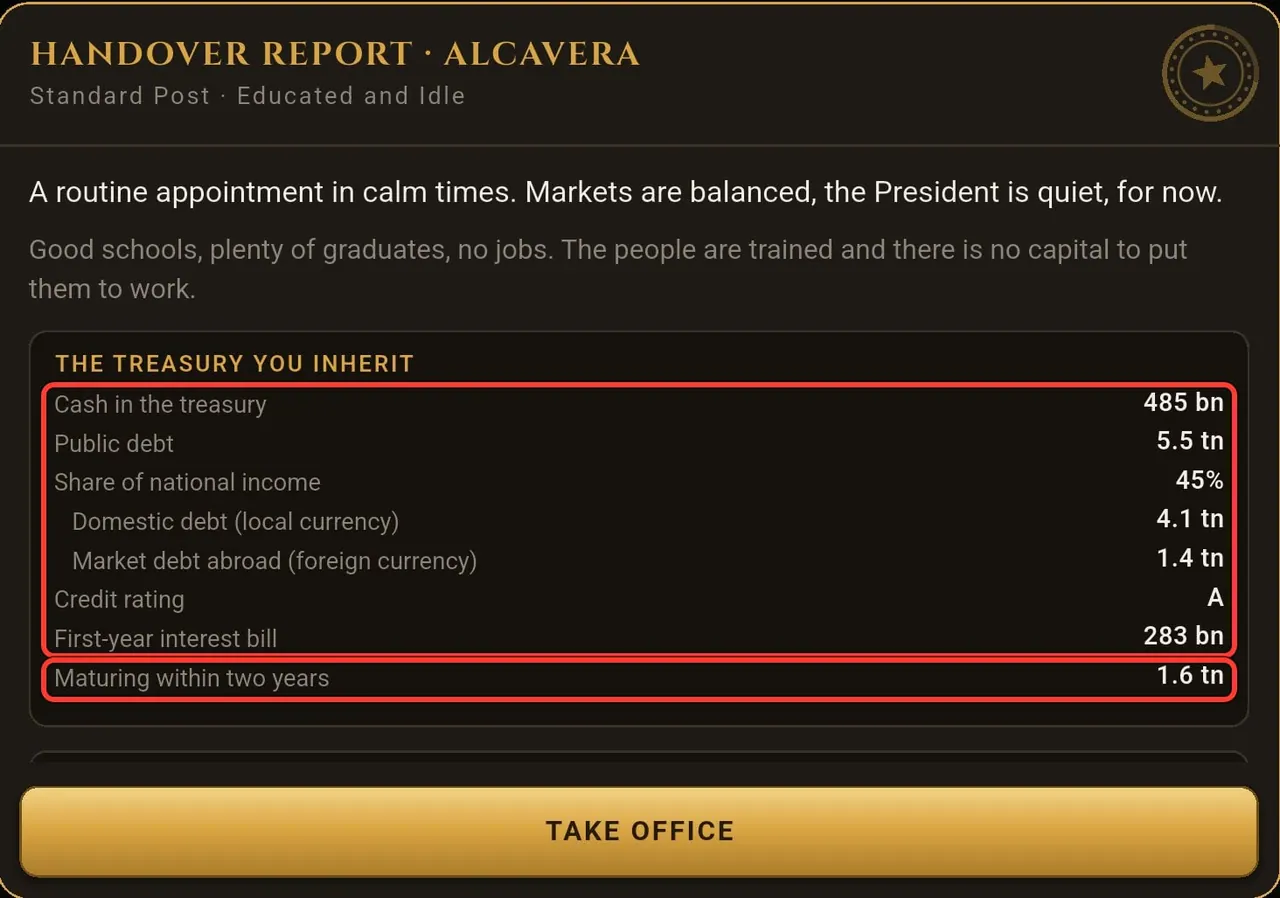
Before you take office, the game shows what you inherit. In Alcavera that is 485 bn in cash, public debt at 45% of national income, an A rating and a first-year interest bill of 283 bn. Note the line "Maturing within two years": that debt has to be rolled over at whatever rate the market asks at the time.
2. Learn the six numbers, and tap them
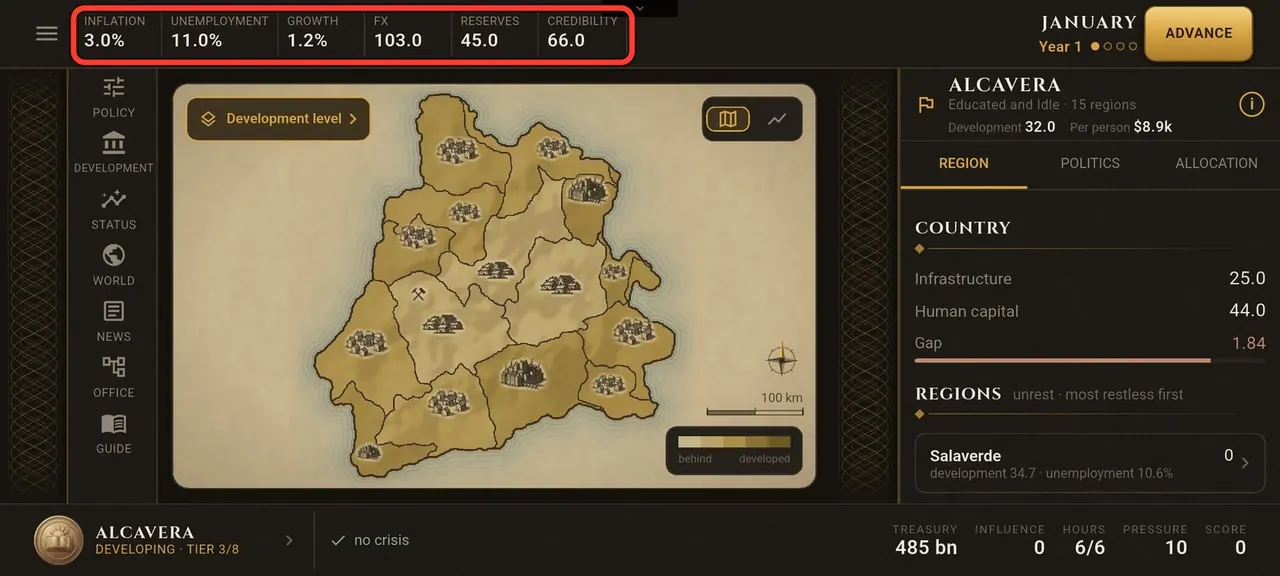
Inflation, unemployment, growth, the exchange rate (FX), reserves and credibility. Tap any of them and the game opens what moves it. It is the fastest way to understand why something happens.
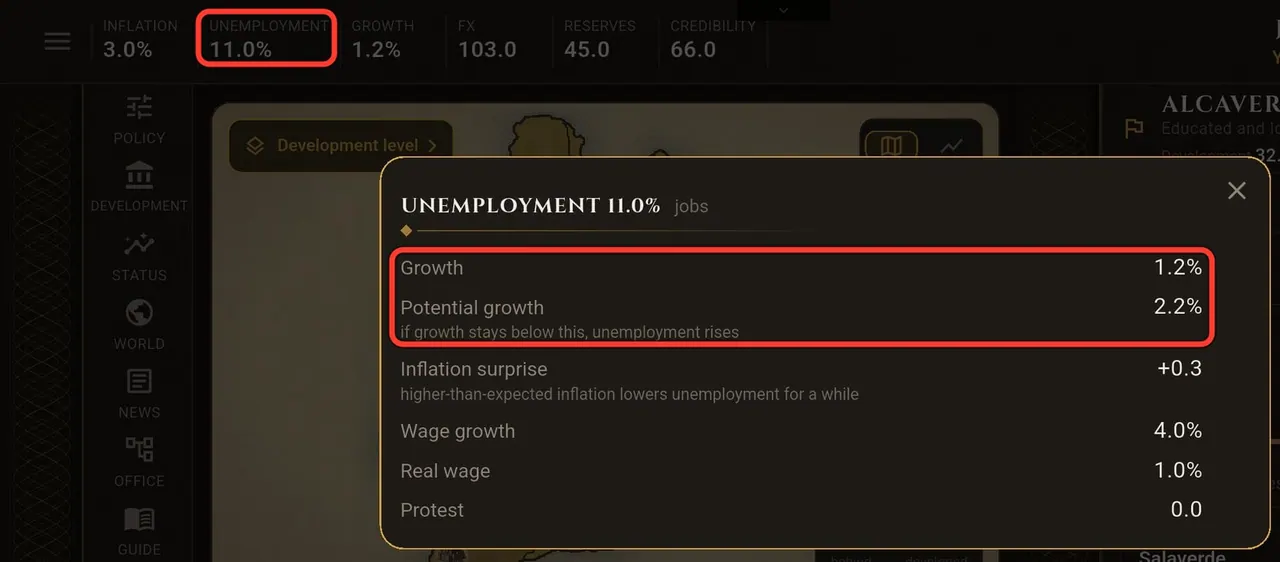
Alcavera starts with 11% unemployment. Tapping the number shows why: growth is 1.2%, but potential growth is 2.2%, and when growth stays below potential, unemployment rises. The cure is not a single programme but faster growth over the years.
3. Every two months: the interest rate
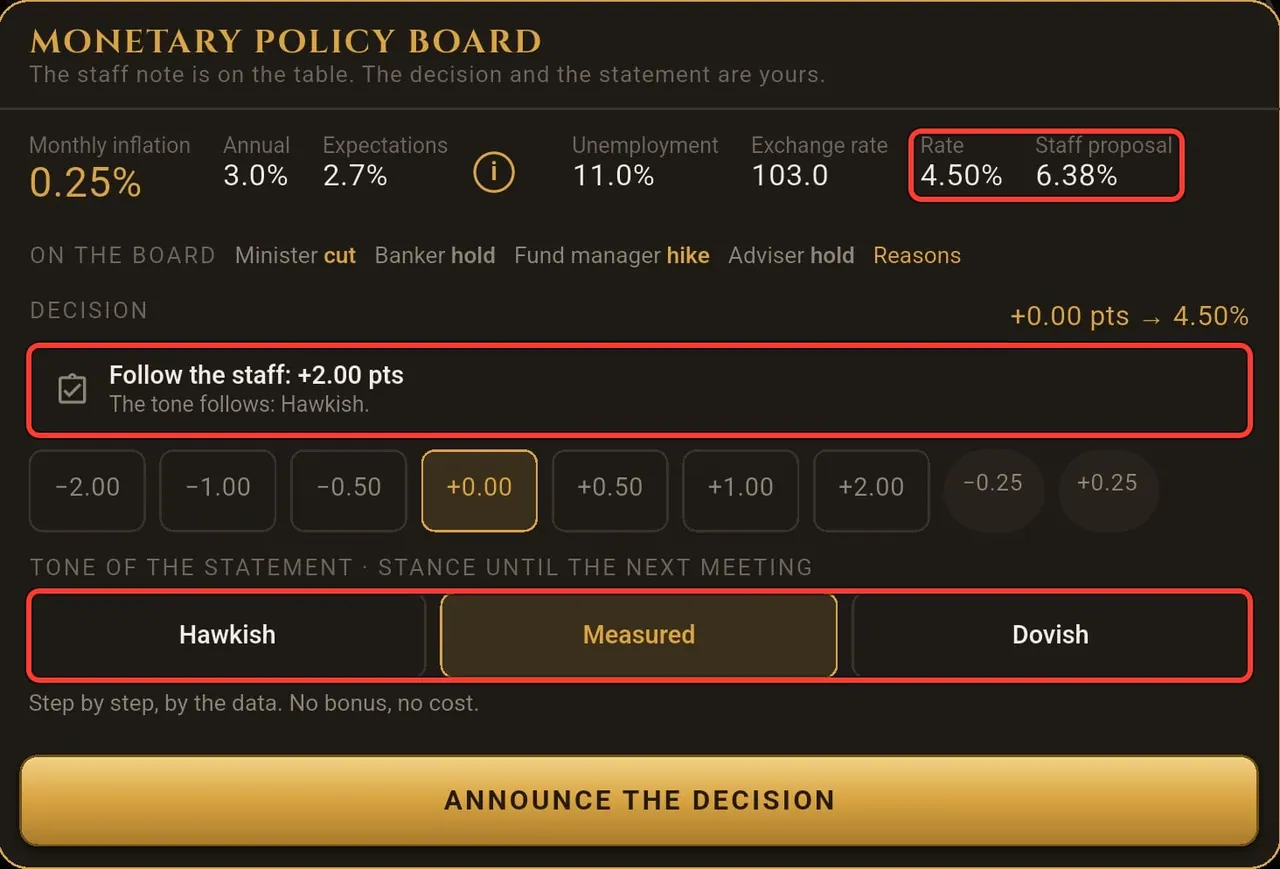
The board meets every two months. You choose a change and the tone of your statement. The staff proposal is a rule of thumb: it looks at how far inflation is from the 2% target and how far growth is from its potential. It does not look at unemployment directly, so it can ask for a hike even when jobs are scarce. That is what happens at Alcavera's first meeting: the rate is 4.50% and the staff propose 6.38%.
"Follow the staff" is a safe default while you learn. When you go your own way, do it on purpose: cut when inflation is under control and growth is weak, hike when inflation is above target and rising. The tone you choose holds until the next meeting; saying one thing and doing another costs credibility.
Keep one side effect in mind: the interest on new domestic debt follows the policy rate. A higher rate cools prices, and it also raises the interest bill.
4. Keep the budget boring
Spending, subsidies and wages are under POLICY › BUDGET, taxes under POLICY › TAX. In the first years, move them in small steps:
- A large VAT increase makes prices jump once and heats up the street.
- A high income tax pushes work into the informal economy, and the revenue goes with it.
- Cutting spending slows growth for a year or two.
- Do not print money to close the deficit. It goes straight into inflation, the exchange rate and credibility.
Try to keep debt below 70% of national income. Above that line, credibility erodes every month and the Palace's pressure rises. There is a separate guide on debt.
5. Watch the bottom bar
The badges in the bottom bar show danger early; tap one to see why. Your term ends if:
- inflation stays above 50% without falling for six months;
- unemployment stays above 25% for three months;
- the exchange rate index reaches 250;
- debt stays above the default threshold for three months;
- Parliament's support stays below 15 for four months;
- or the Palace removes you after an ultimatum.
None of these comes without warning.
6. When something goes wrong, open the GUIDE
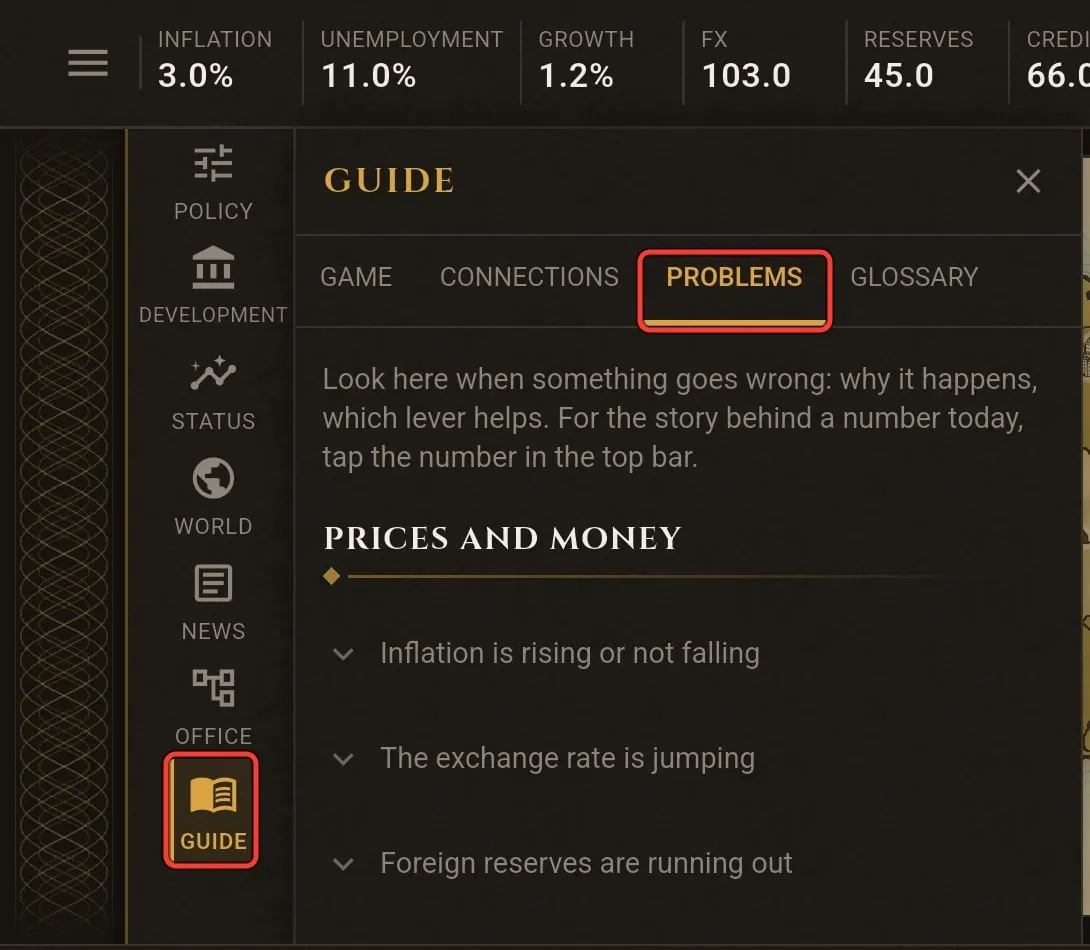
The GUIDE section has four tabs. GAME explains the basics, CONNECTIONS shows which lever moves what, PROBLEMS lists the usual troubles with their causes and fixes, and GLOSSARY explains terms such as VAT. The ⓘ at the top right of every panel explains that panel's tools one by one.
A short example: Alcavera's first year
Alcavera is educated and idle: good schools, plenty of graduates, no capital to put them to work. Unemployment is 11%, inflation 3% and debt 45% of national income.
A sensible first year:
- At the board, follow the staff.
- Leave taxes and spending mostly alone; if you touch them, move a point or two.
- Open DEVELOPMENT › INVESTMENT and keep investment above maintenance. That is what builds infrastructure and human capital, and through them income per person. The payoff takes years, which is exactly why it should start in year one.
Then press ADVANCE and watch. If a number moves the wrong way, tap it before you touch a lever.