 ablut

Surviving the Palace
The most common way a run in Faith ends is the Palace removing you. Where its pressure comes from, how the ultimatum works, and how to keep it down.
· 4 min read
More runs in Faith end this way than any other: the Palace loses patience and removes you. It rarely comes out of nowhere. Palace pressure builds a little every month, and the game shows it the whole time.
The problem: the Palace removes you
PRESSURE sits in the bottom bar, from 0 to 100. When it reaches 100, an ultimatum arrives: you have three months to bring it below 85 (two months from the second ultimatum on). If you don't, you are removed from office and the run ends.
Why: pressure builds month by month
On its own, pressure falls by half a point a month. These push it up:
- A hawkish tone: about one point a month while you keep it.
- Transparency: an open central bank (POLICY › BANKS) adds a little every month. The Palace can no longer ask for quiet favours.
- Debt above 70% of national income: a little more for every point above the line.
- Wages that lag inflation by more than two points.
- Reform as your public order (DEVELOPMENT › GOVERNANCE).
- Refusing the Palace's demands: 10 to 22 points depending on the demand, and refusing the same kind again costs more each time.
- One-off shocks: an IMF programme, restructuring the debt, a leak that gets caught, and some choices on street, media and parliament cards.
As pressure climbs, the Palace changes. Above 50, the minister on your board asks for rate cuts. Above 60, its demands come more often. Above 70, it stops asking and starts acting: some months it cuts your rate, prints money or lowers the banks' reserve requirement on its own.
What to do
1. Answer demands with the full menu
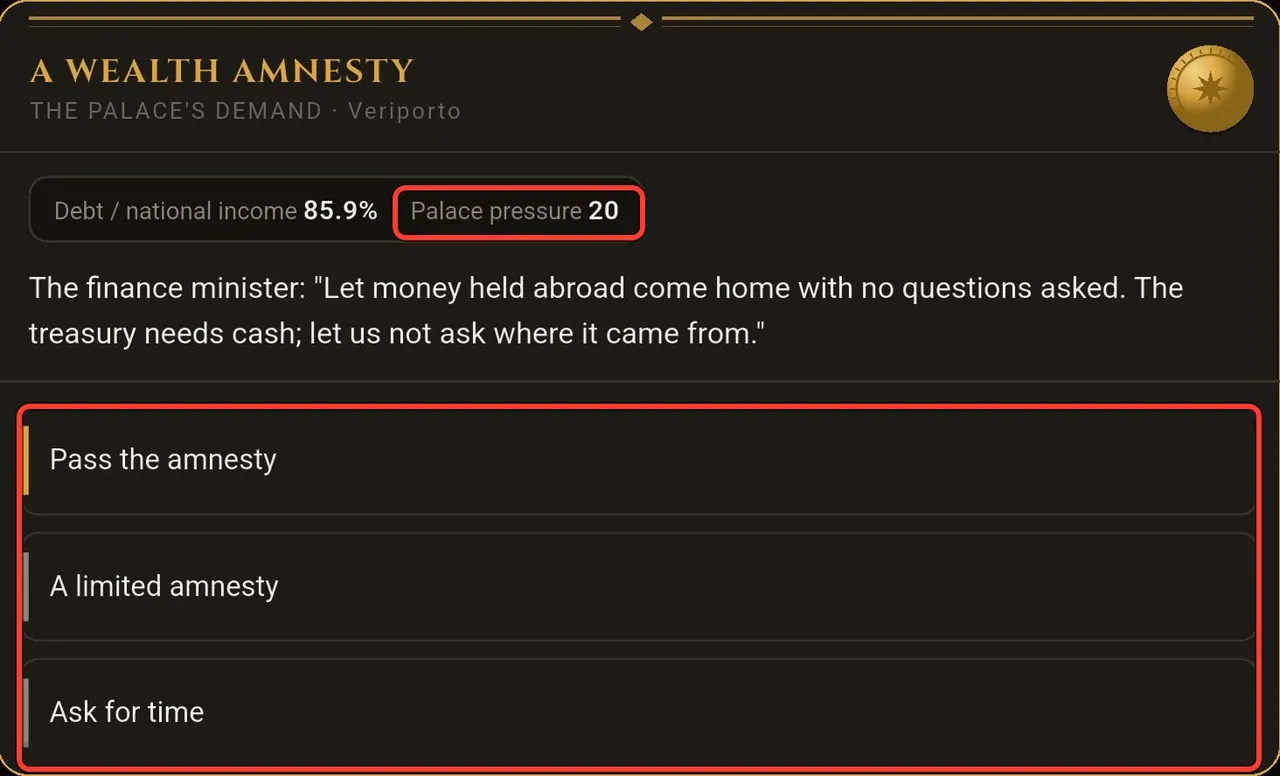
Each demand card has four choices; scroll the card for the last one.
- Give in (here, "Pass the amnesty"): pressure −5, but corruption grows and the Palace's network gets stronger. Demands about money (cut the rate, print, defend the currency) also jolt inflation and expectations at once.
- Bargain ("A limited amnesty"): half the effect on both sides. Pressure −2, and it costs influence.
- Ask for time: pressure +3. The Palace comes back in three to six months, harder, and it will not wait a second time.
- Refuse: the pressure from the list above, but you gain influence. Refusing is your right; just don't refuse everything when you are already near 100.
2. Use covert ops before you need them
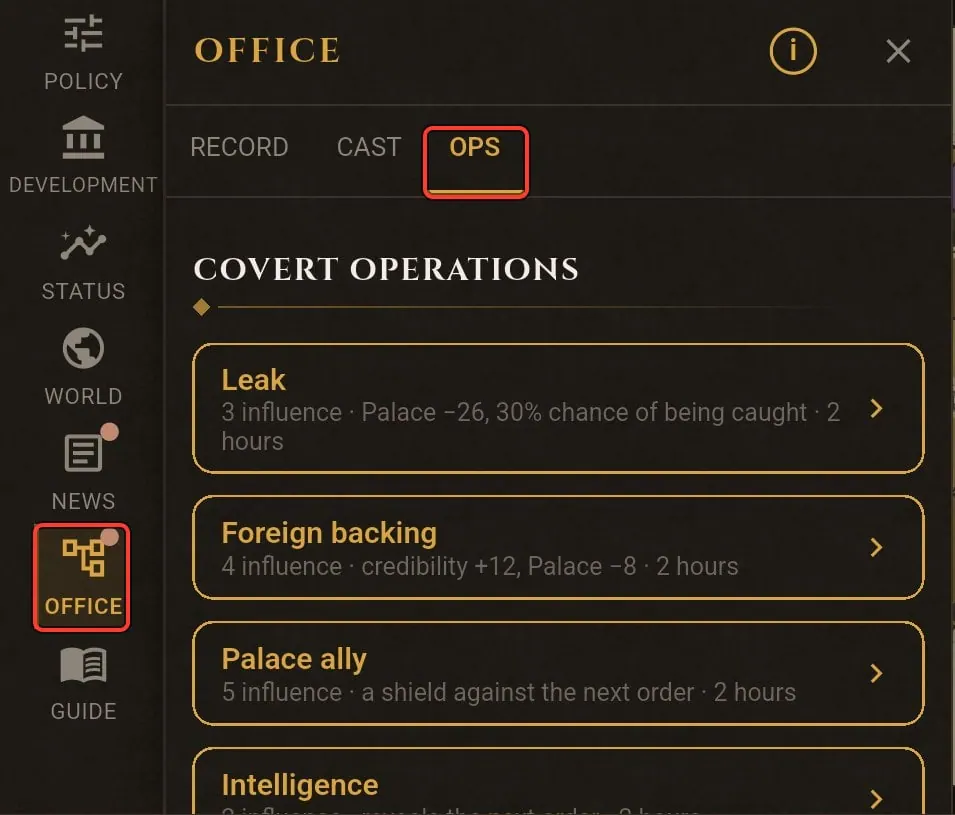
OFFICE › OPS is the strongest tool. You can run one op a month, paid with influence and two working hours:
- Leak: pressure −26, but next month there is a 30% chance it is traced back to you (+15). Every leak in the last 12 months makes the next one easier to catch.
- Foreign backing: credibility +12, pressure −8.
- Palace ally: your next refusal costs no pressure.
- Rumour: your next refusal costs half, and pressure −6.
- Intelligence: shows the next demand before it arrives, and pressure −5.
A good habit: when pressure passes 60, get ready. Buy a Palace ally or a Rumour before a demand you mean to refuse.
3. Mind the tone
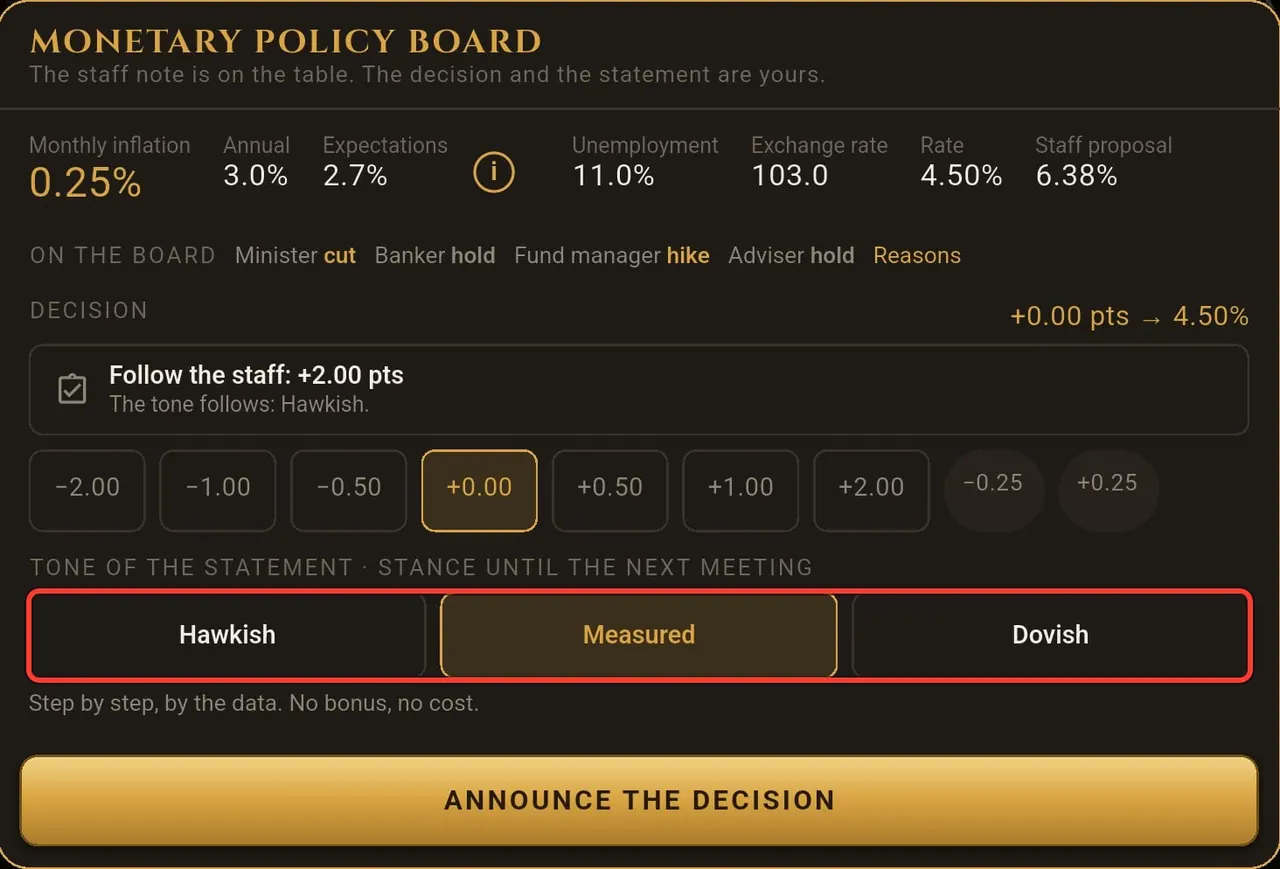
At the board, Hawkish adds pressure every month and Dovish takes about a point off every month. Dovish is not free: it costs a little credibility each month and shifts expectations, so inflation becomes harder to bring down. Measured has no bonus and no cost. Switching to Dovish for a few meetings is a fair way out of a tight spot.
4. Remove the slow sources
- Bring debt below 70% (see the guide on debt).
- Keep wage raises close to inflation.
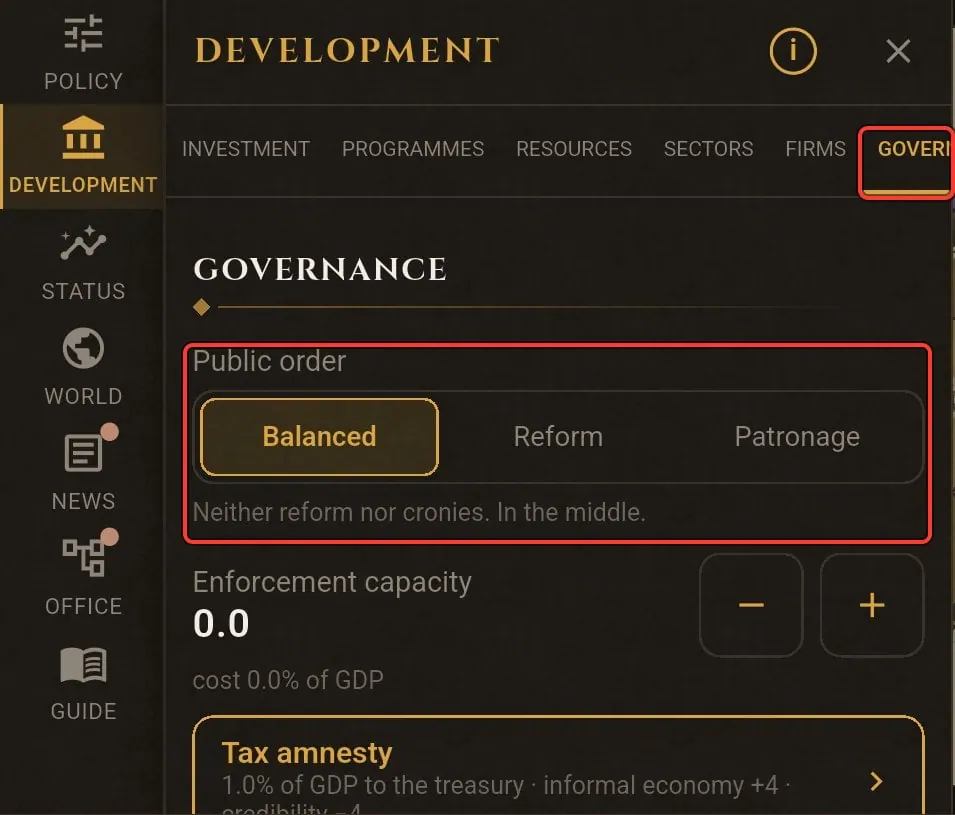
- Under DEVELOPMENT › GOVERNANCE, Public order sets how the state runs. Reform cuts corruption and builds credibility, but adds pressure every month. Patronage lowers it every month, but corruption and the Palace's network grow. Balanced sits in the middle.
- Defence projects help a little: the Palace reads defence capacity as loyalty, and pressure falls a bit faster.
A short example: Alcavera in year 8
In this run's eighth year, Alcavera's pressure is 20, but debt has climbed to 85.9% of national income, which alone adds about a quarter of a point a month. Then a demand arrives: a wealth amnesty, "let money held abroad come home with no questions asked".
At 20, you can afford to refuse: +10 now, plus influence for later. At 80, the same refusal would put you within reach of an ultimatum. There, the limited amnesty, a Rumour first, or a few dovish meetings are the safer road.
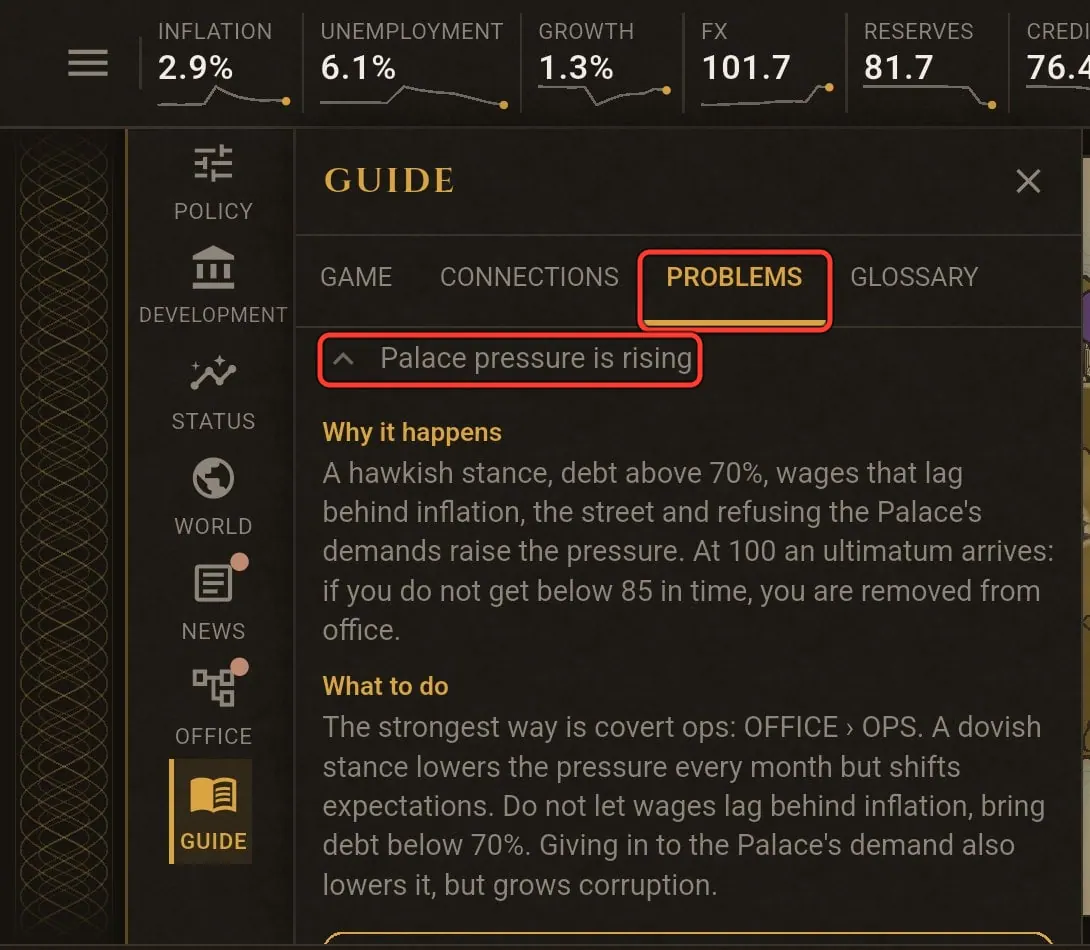
The same advice is in the game, under GUIDE › PROBLEMS › "Palace pressure is rising".
More guides

Faith: Economy Simulation · 5 min read
Your first years in Faith
Where to look, what to decide and what to leave alone in your first two years, with Alcavera as the example.

Faith: Economy Simulation · 5 min read
Why debt keeps rising, and how to bring it down
The debt ratio has its own momentum. What drives it in Faith, how to read the DEBT tab, and which levers actually work.

Faith: Economy Simulation · 4 min read
Why the exchange rate jumps, and how to stop a currency crisis
The second most common way a run ends is a currency crisis. What moves the exchange rate in Faith, why reserves matter so much, and which tools buy time and which fix the cause.

Faith: Economy Simulation · 5 min read
The eight countries, and where each one starts
Each country in Faith opens with its own numbers and its own weak spot. What you inherit in each, and what to look at first.