 ablut
Playing the Crises
Faith's Crises drop you into a real economic crisis, with its dates, its events and its hard choices. How a crisis pack works, how to read your goals and how the medals are won.
· 4 min read
Story mode gives you sixty years. A crisis gives you four to six, starting when things are already going wrong. Faith's Crises are short scenarios built on real economic crises: the same kind of country, the same calendar of events, and the same choices the real governments faced. The countries are fictional; the dates and the decisions are not.
The problem: a crisis does not wait
In story mode you can learn slowly. In a crisis, the clock starts at once. In India 1991, reserves cover about two weeks of imports, a war is starting abroad and the budget is deep in deficit. If you play it like a calm story run, the run gets away from you within months.
Why: what is different in a crisis
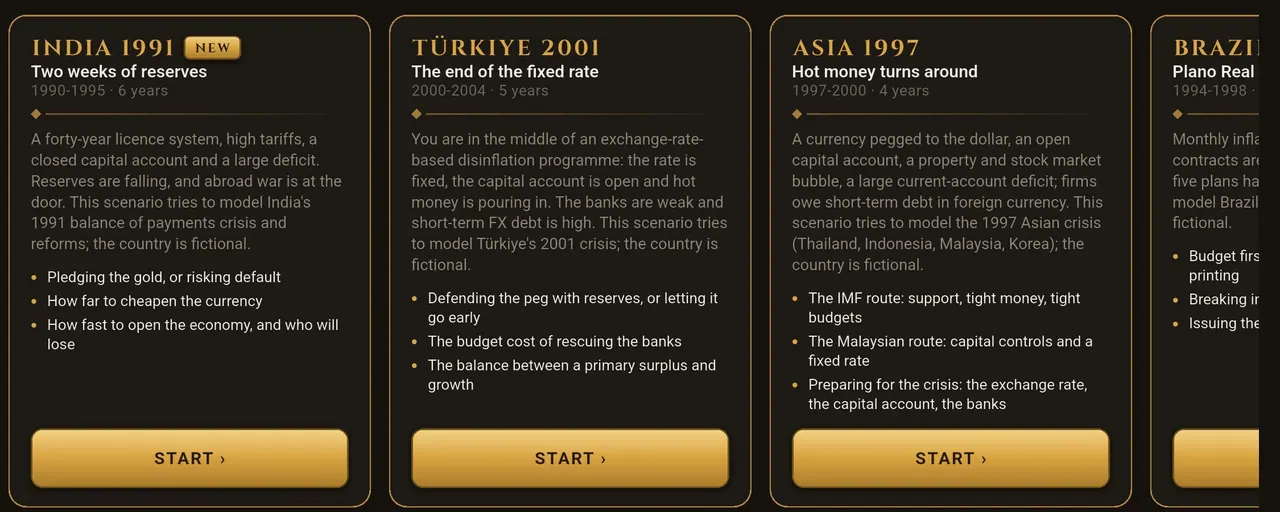
There are four crises today, each sold as its own pack:
- India 1991, Two weeks of reserves (1990-1995): a forty-year licence system, high tariffs and a balance of payments crisis.
- Türkiye 2001, The end of the fixed rate (2000-2004): a currency peg, hot money and weak banks.
- Asia 1997, Hot money turns around (1997-2000): a peg, a property bubble and short-term debt in foreign currency.
- Brazil 1994, Plano Real (1994-1998): monthly inflation of 40% and five failed plans.
USA 1979 and Argentina 2001 are on the way.
Three things change from story mode:
- Dated goals. Surviving earns the lowest medal; the better ones are won on goals with deadlines.
- A real calendar. Events arrive on their historical dates, each with a short "In reality" note on what actually happened.
- Crisis tools. Each pack adds the levers of its own crisis, such as a controlled devaluation in India or the URV in Brazil.
The levers you know from story mode are all still there: the board, the budget, taxes, debt and the currency.
What to do
1. Read your goals before the first month
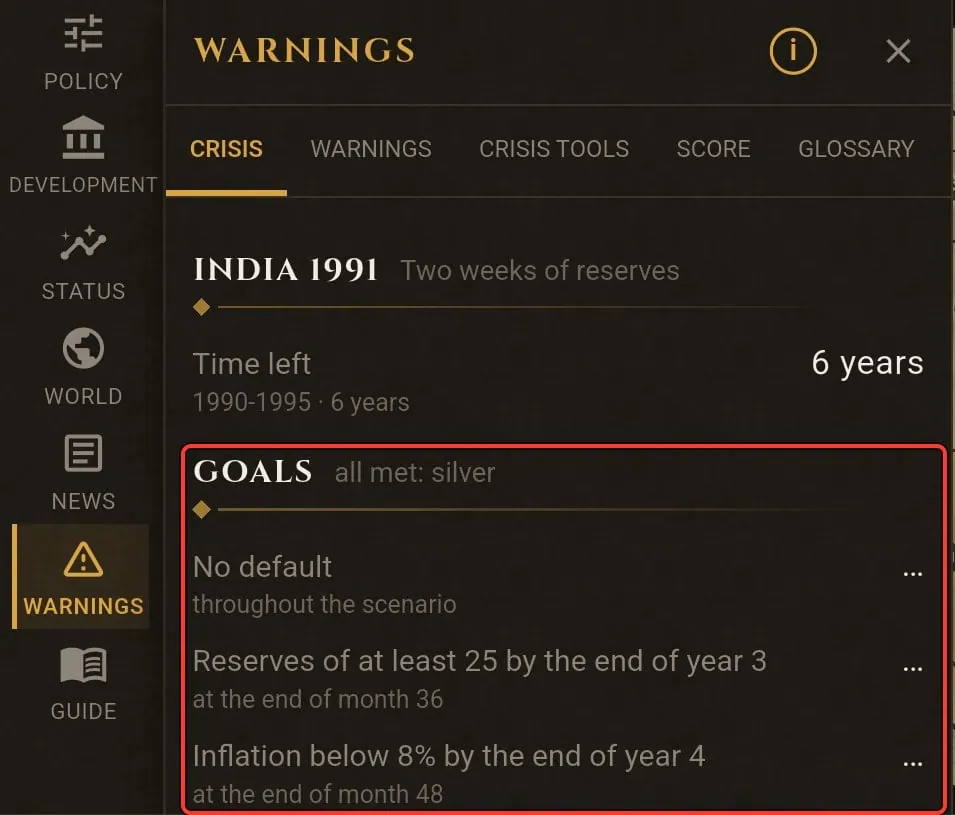
Open WARNINGS › CRISIS. It shows the time left and every goal with its deadline. In India 1991 they are:
- no default, throughout the scenario;
- reserves of at least 25 by the end of year 3;
- inflation below 8% by the end of year 4;
- all three reform steps taken by the end of year 5;
- growth of at least 4% in year 6.
Plan backwards from the deadlines. A goal for year 5 needs decisions in year 1.
2. Know what each medal asks
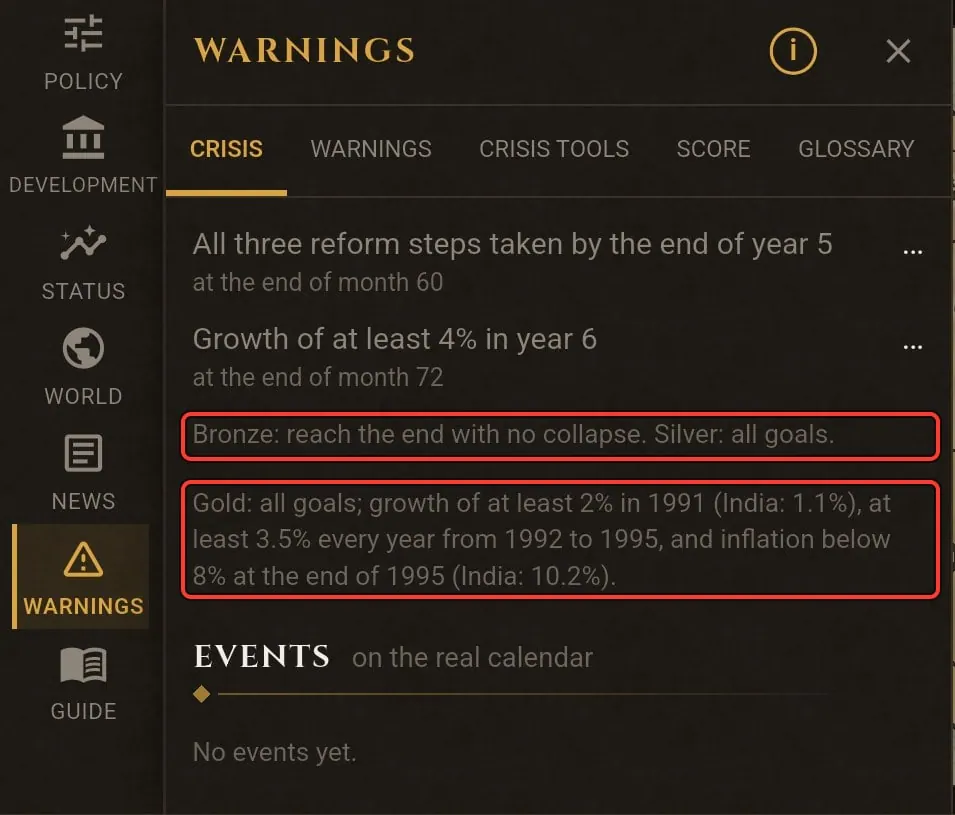
- Bronze: reach the end with no collapse.
- Silver: all goals.
- Gold: all goals, plus a harder test measured against the real country. In India 1991, gold also asks for growth of at least 2% in 1991, while India managed 1.1%.
A pack left unfinished earns no medal. When a pack ends, you can carry on in Sandbox.
3. Use the crisis tools, in the right order
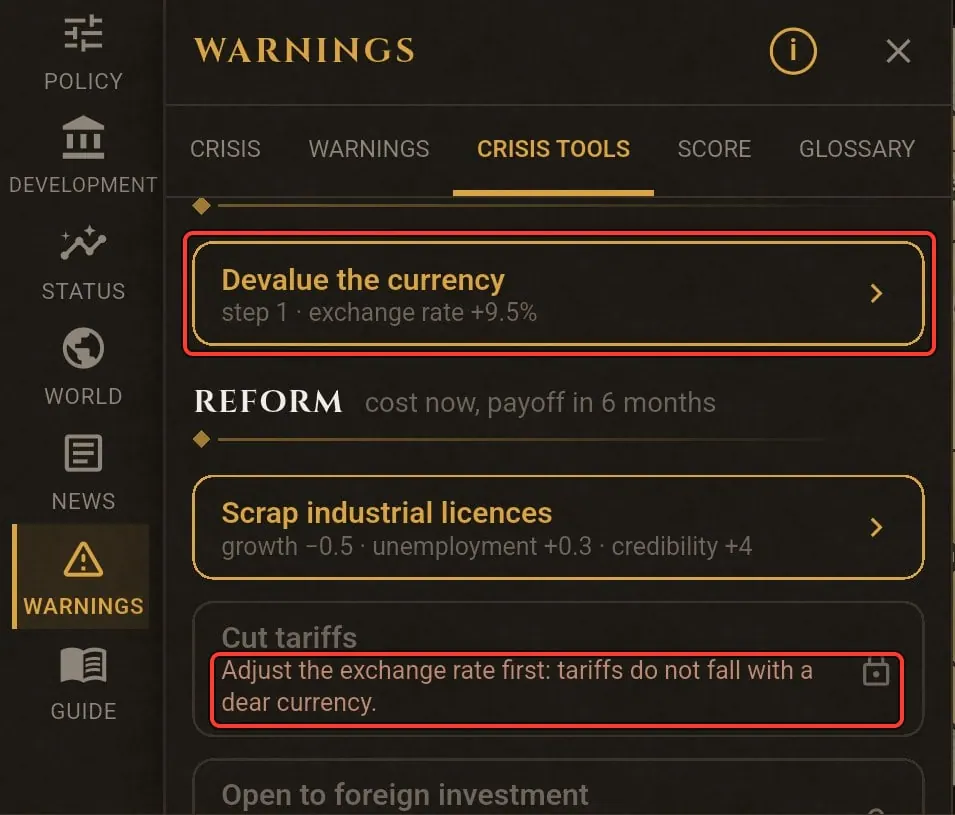
WARNINGS › CRISIS TOOLS holds the pack's own levers, and many come in a set order. In India 1991, tariffs cannot fall while the currency is still dear, and foreign investors will not come while the licence regime stands. So the order is: devalue, scrap the licences, then cut tariffs and open to investment. Reforms cost something now and pay off about six months later; the cost is shown before you commit.
The same tab has the general emergency tools, such as a price cap or a currency reform, with the conditions under which they open.
4. Read every card to the end
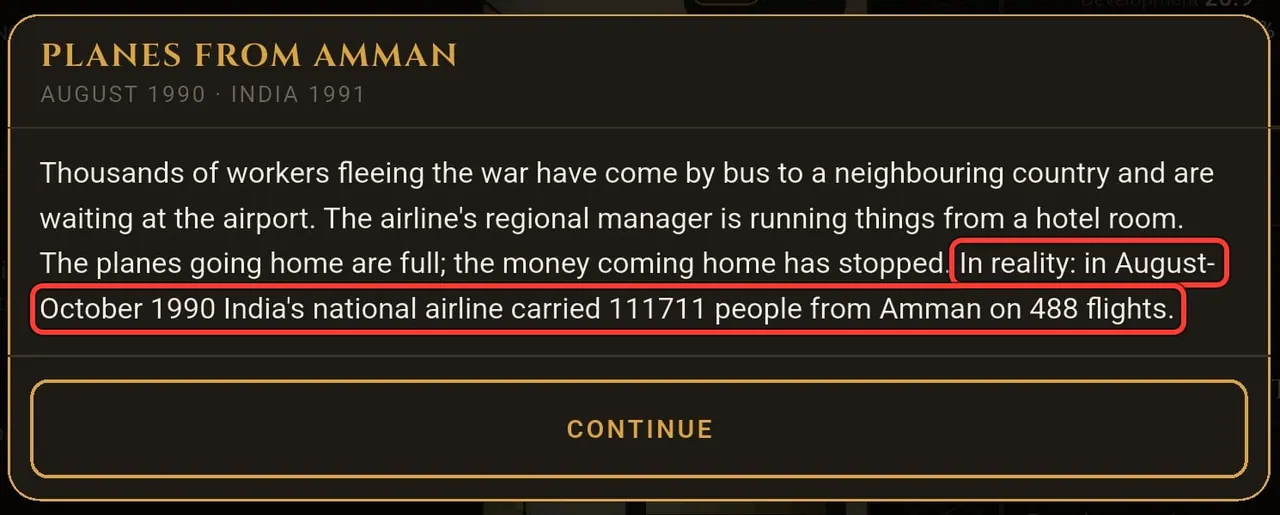
Event cards follow the real calendar. Some only tell you what happened; others ask for a decision and show what each choice does to your numbers before you choose.
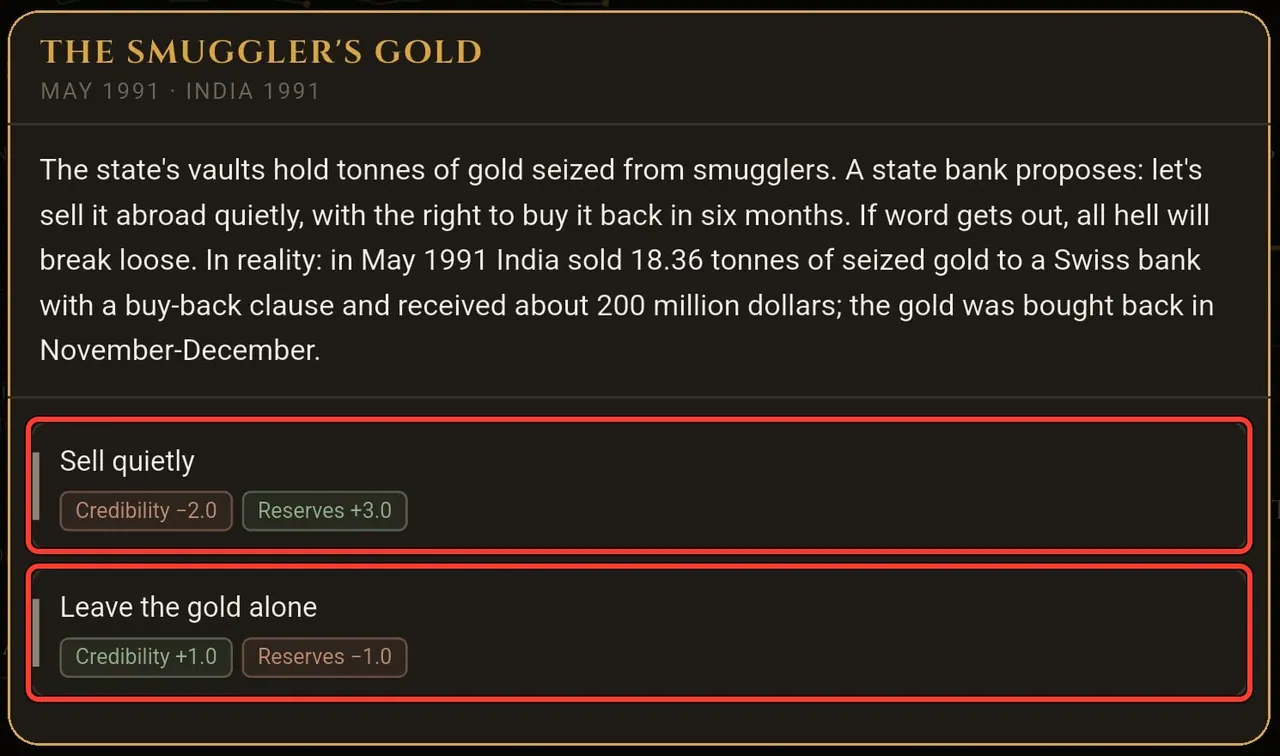
In May 1991 the state can quietly sell gold seized from smugglers, with the right to buy it back. Selling gives reserves +3.0 and costs credibility −2.0. Leaving the gold alone gives credibility +1.0 and costs reserves −1.0. Neither choice is right in every run: it depends on how close you are to the edge. The "In reality" note tells you what India did, which is a hint but not an order.
5. Watch the score multiplier
WARNINGS › SCORE shows your score and the multiplier: a harder crisis scores more, and a streak of stable years raises it further. Turning back a crisis also earns a bonus.
A short example: India 1991, the first months
At the start, inflation is 9.4%, credibility is 40, reserves are 22 and the rate is 12%. At the first board, the staff propose 24.78%.
In a test run that did nothing but follow the staff, reserves fell from 22 to 11.2 by July 1990 and to 4.2 by September. The board alone cannot save a country that is running out of foreign currency. Reach for the crisis tools early, starting with the controlled devaluation, and weigh every card by what it does to reserves. The guide on currency crises explains the forces behind the exchange rate, and they work here too.
Crises are sold in the STORE, under CRISES, one pack at a time. Once bought, a pack starts from the main menu under CRISES.
More guides

Faith: Economy Simulation · 5 min read
Your first years in Faith
Where to look, what to decide and what to leave alone in your first two years, with Alcavera as the example.

Faith: Economy Simulation · 5 min read
Why debt keeps rising, and how to bring it down
The debt ratio has its own momentum. What drives it in Faith, how to read the DEBT tab, and which levers actually work.

Faith: Economy Simulation · 4 min read
Surviving the Palace
The most common way a run in Faith ends is the Palace removing you. Where its pressure comes from, how the ultimatum works, and how to keep it down.
Faith: Economy Simulation · 4 min read
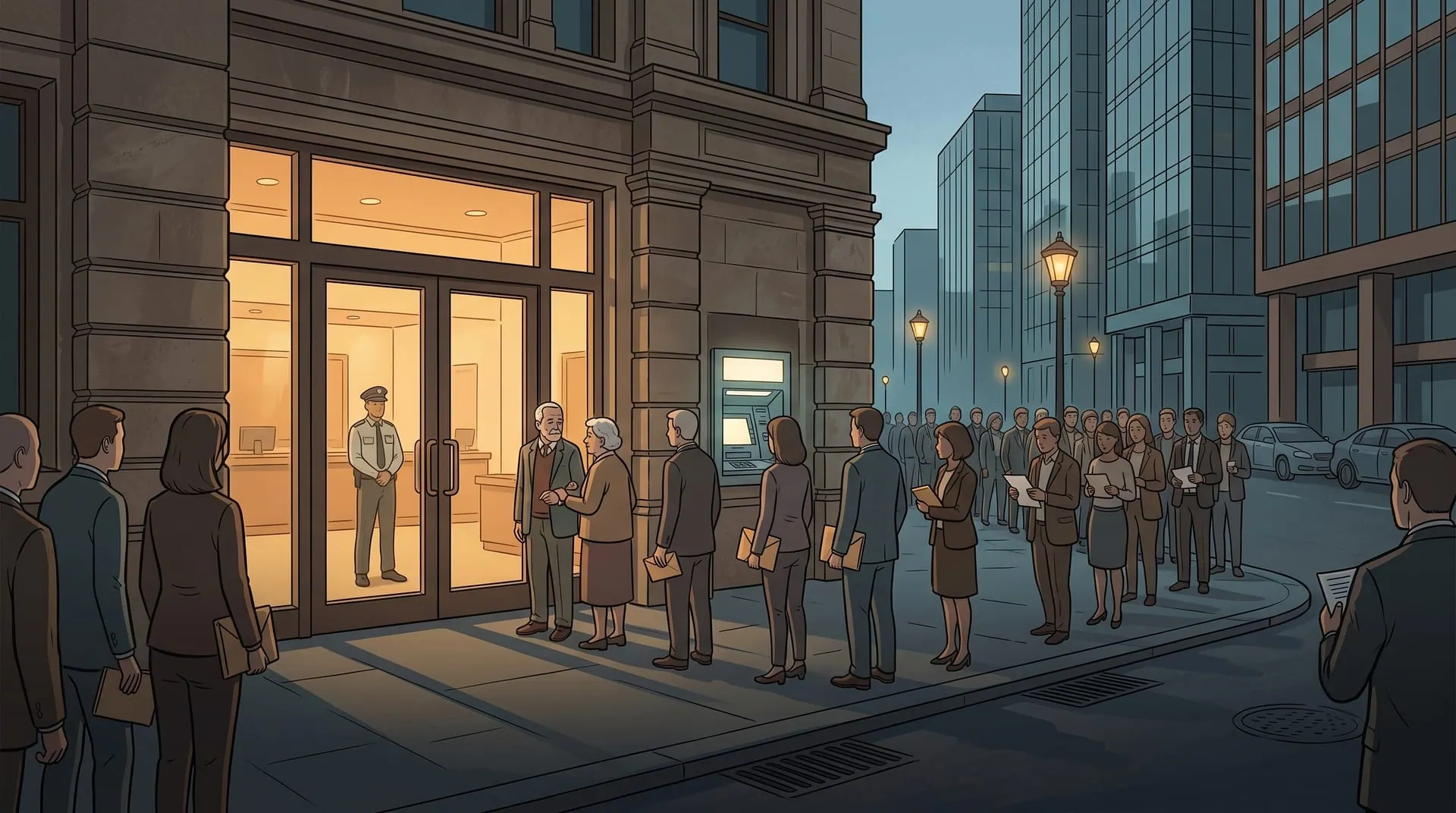
Why the exchange rate jumps, and how to stop a currency crisis
The second most common way a run ends is a currency crisis. What moves the exchange rate in Faith, why reserves matter so much, and which tools buy time and which fix the cause.