 ablut

Bringing inflation down
You raise the rate and inflation does not move. Why prices in Faith have a memory, what the inflation window tells you, and the levers that bring inflation down for good.
· 5 min read
You raise the rate, then raise it again, and inflation is still 20%. Players ask about this a lot. The rate works, but not on its own and not at once. Inflation has a memory, and the game shows every part of it.
The problem: inflation does not come down
You hike, you wait, and the yearly figure barely moves. Meanwhile growth slows and the street grows impatient.
Why: prices remember
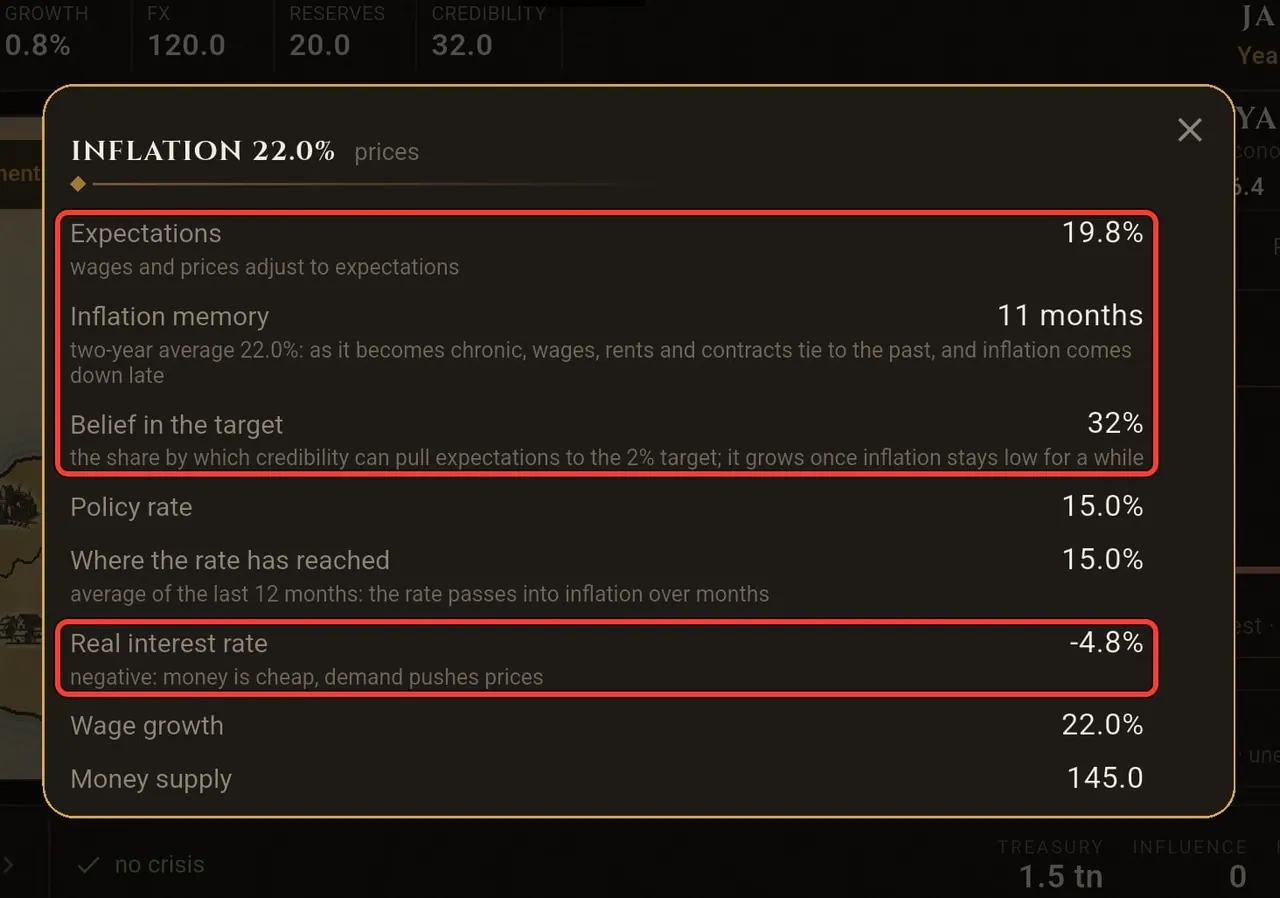
Tap INFLATION at the top of the screen. The window lists what holds prices up:
- Expectations. Wages and prices adjust to the inflation people expect.
- Inflation memory. As inflation becomes chronic, wages, rents and contracts tie themselves to the past, and inflation comes down late.
- Belief in the target: how far credibility can pull expectations to the 2% target. It grows only once inflation has stayed low for a while.
- Where the rate has reached. This is the average of the last 12 months, because the rate passes into inflation over months. A hike today is only a small part of that average.
- Real interest rate: your rate minus expected inflation. While it is negative, money is cheap and demand pushes prices up.
- Wage growth, money supply and the exchange rate. Raises, printed money and a sliding currency all pass into prices.
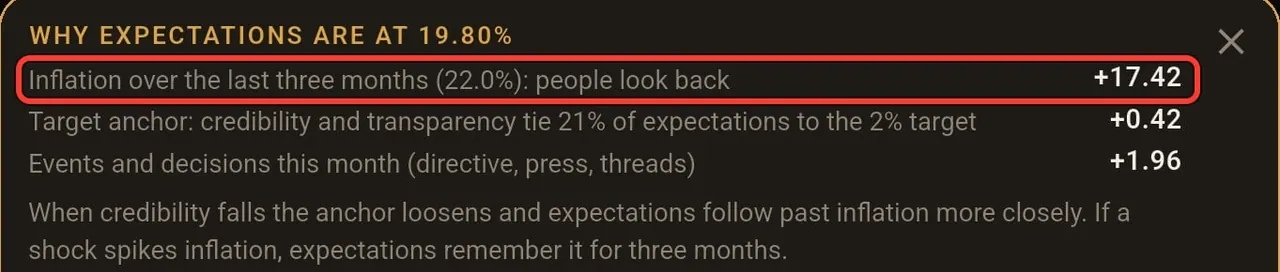
At the board, the ⓘ next to Expectations breaks them down. Most of the number is the inflation of the last three months: people look back. Only the part tied to the target looks forward, and that part grows with credibility and transparency.
So a hike alone is slow. It has to push the real rate above zero, hold it there for months, and wait for the last three months of inflation to fall. Meanwhile the other channels keep feeding prices.
What to do
1. Get the real rate positive, and keep it there
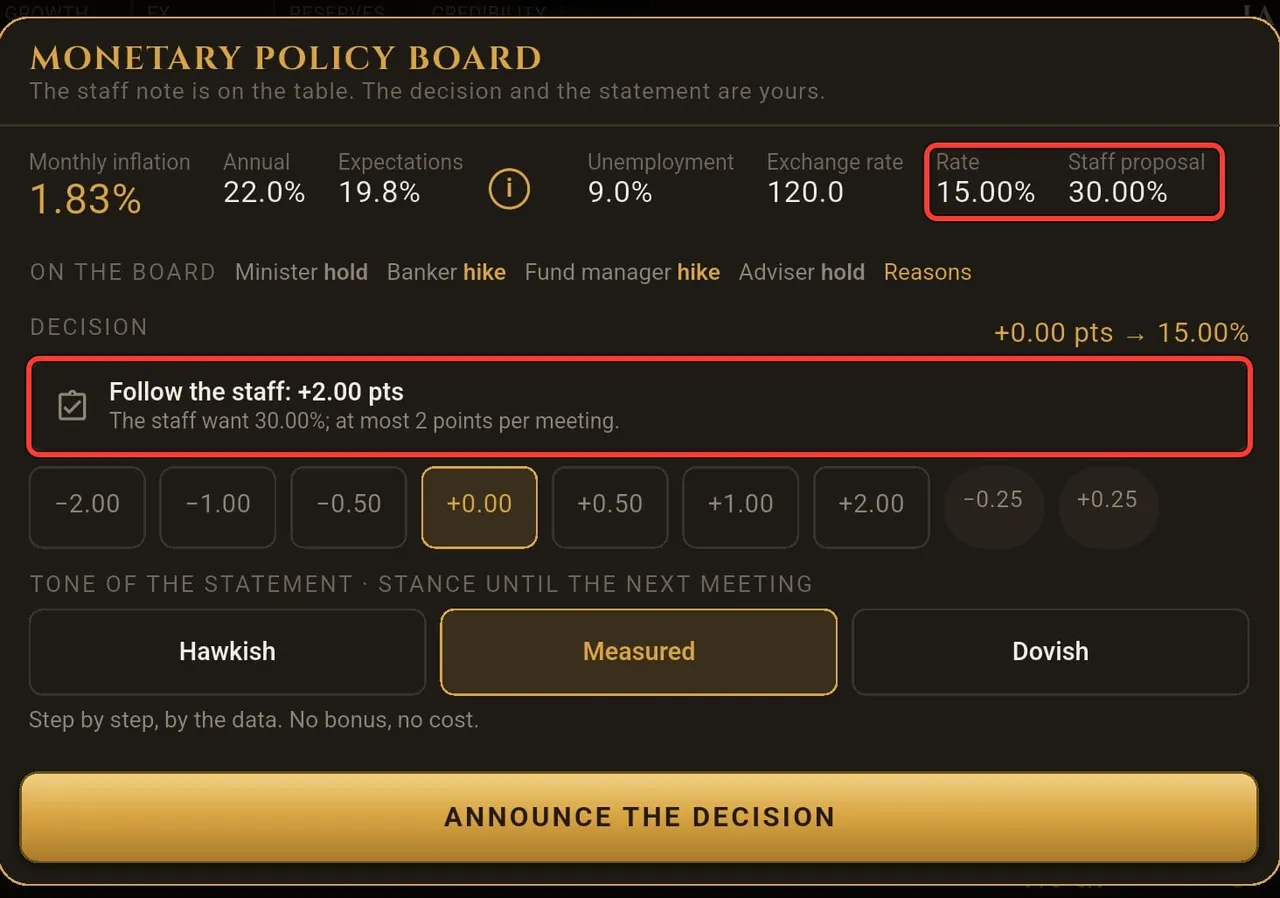
The staff proposal is the rate that pulls inflation to the 2% target. "Follow the staff" moves the rate that way by at most 2 points per meeting, and the board meets every two months. When the gap is large, the climb takes many meetings, and the game's own advice is: "Keep the interest rate above inflation and be patient: the effect spreads over a year."
2. Use the tone
The statement's tone is a decision too. Hawkish pulls expectations to the 2% target and earns credibility every month once inflation is between 1% and 3%, but it raises Palace pressure. Dovish pushes expectations up and melts credibility. A tone that contradicts your decision costs the market's trust, so hike with a hawkish voice, not a dovish one.
3. Stop feeding prices from the budget
- Stop printing money. It passes straight into inflation. Under POLICY › DEBT, set deficit financing to Market.
- Go easy on VAT. A VAT rise makes prices jump once, then fades.
4. Break the wage spiral
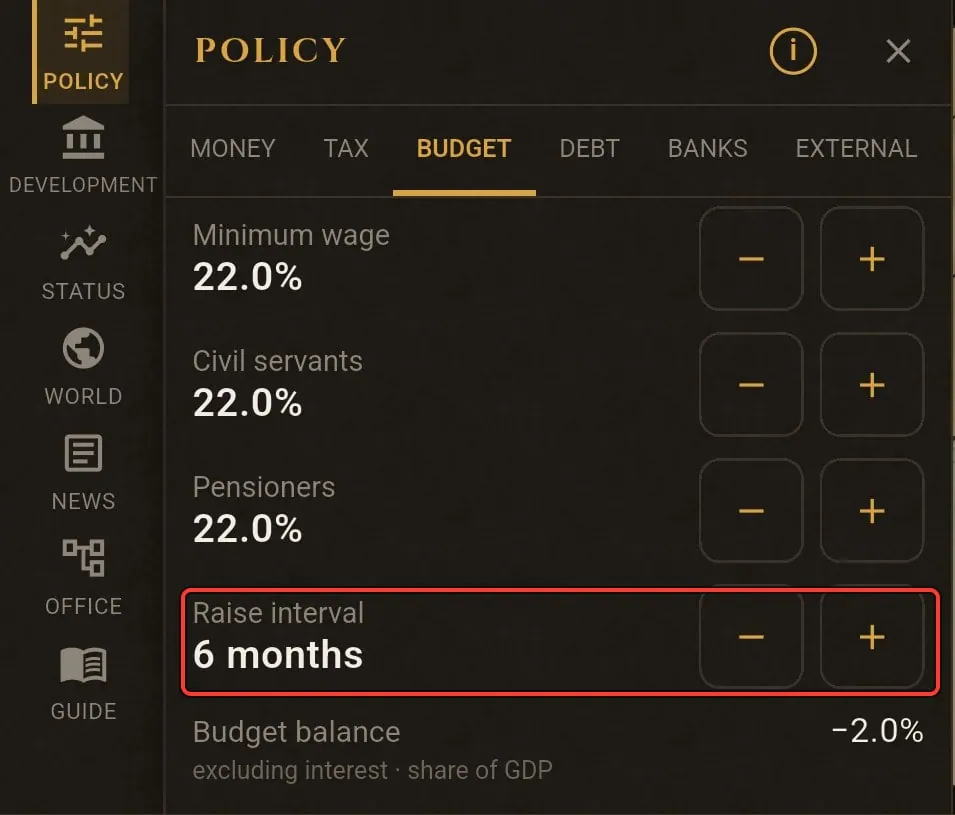
Under POLICY › BUDGET, look at the raises and the Raise interval. A short interval writes past inflation into wages more, and inflation becomes persistent and harder to bring down. Twelve months indexes the least, three months the most. At the pay table the union asks for at least the period's inflation, and employers warn that anything above productivity goes into prices. Keep raises close to inflation, not far above it, and do not shorten the interval.
5. For high inflation: a stabilisation programme
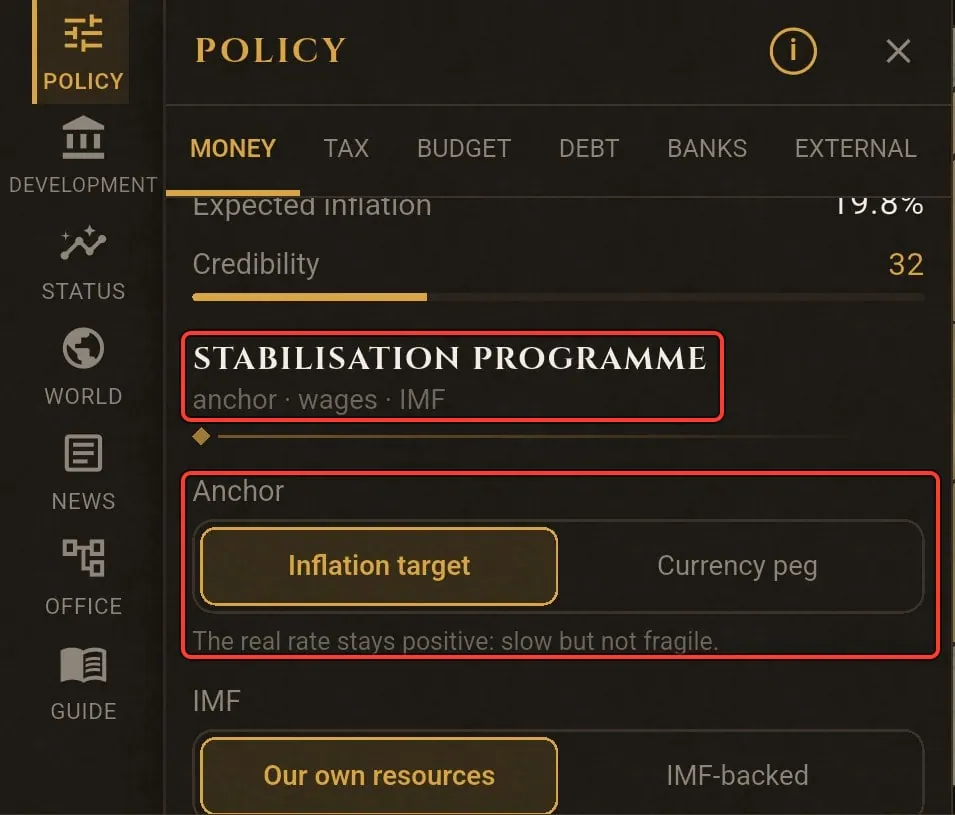
Under POLICY › MONEY, the Stabilisation programme puts everything above into one package. It opens when there is a stability problem: inflation above 10%, a credit rating below B, or debt 30 points above carrying capacity. It combines:
- a fiscal target: the primary balance 3 points better within 12 months;
- an inflation path down to 5%;
- a wage agreement that ties raises to the path instead of past inflation;
- an anchor of your choice: an inflation target (slow but not fragile) or a currency peg (inflation falls fast, but reserves melt and the peg can break);
- the IMF, if you want its support.
Confidence in the programme pulls expectations to its path. Every condition you meet raises it; printing money cuts it. If confidence falls too low, the programme collapses.
A short example: Nusaraya's first month
Nusaraya starts with 22% inflation, expectations at 19.8% and the rate at 15%. The real rate is −4.8%: money is cheap and demand pushes prices. Of those 19.8 points of expectations, 17.42 come from the last three months of inflation and only 0.42 from the 2% target. Belief in the target is 32%. The minimum wage, civil-service pay and pensions are all set to rise 22% a year, with a raise every six months.
The staff want 30%. At 2 points per meeting and a meeting every two months, today's proposal is eight meetings away: well over a year. That is the "be patient" in the game's advice, made concrete.
A sensible first year:
- Follow the staff at every meeting, with a hawkish tone.
- Lengthen the raise interval, and keep raises close to inflation.
- Finance the deficit from the market, not by printing.
- After the first month's budget has closed, consider the stabilisation programme with an inflation-target anchor.
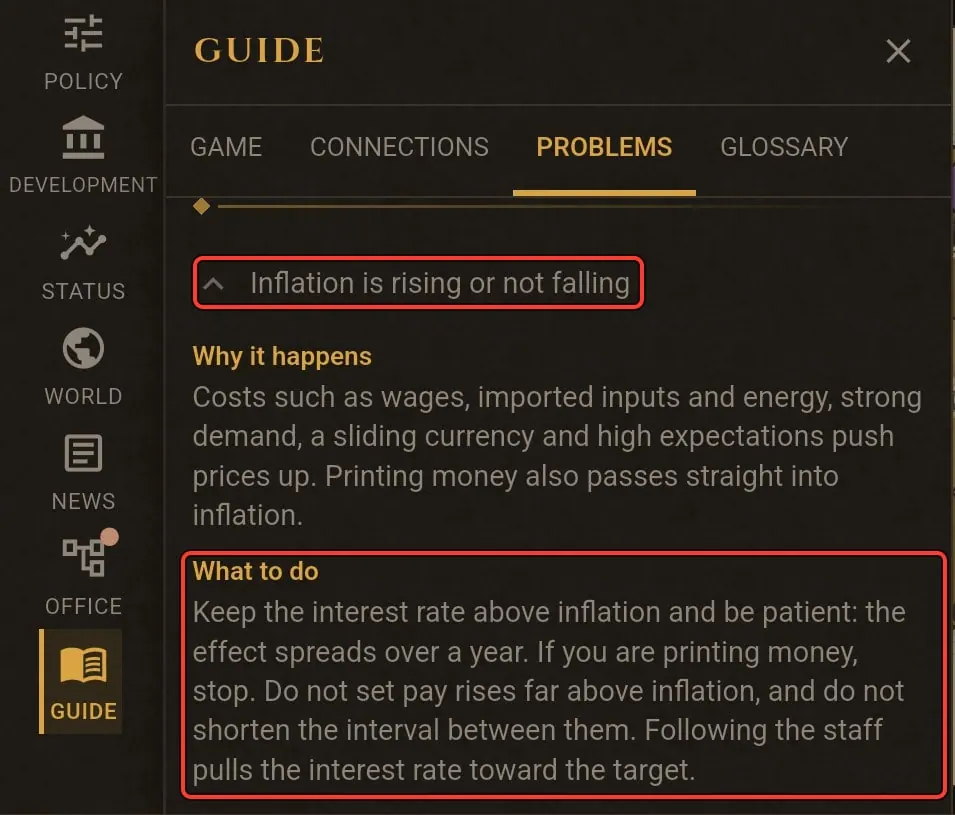
The short version is in the game, under GUIDE › PROBLEMS › "Inflation is rising or not falling".
More guides

Faith: Economy Simulation · 5 min read
Your first years in Faith
Where to look, what to decide and what to leave alone in your first two years, with Alcavera as the example.

Faith: Economy Simulation · 5 min read
Why debt keeps rising, and how to bring it down
The debt ratio has its own momentum. What drives it in Faith, how to read the DEBT tab, and which levers actually work.

Faith: Economy Simulation · 4 min read
Surviving the Palace
The most common way a run in Faith ends is the Palace removing you. Where its pressure comes from, how the ultimatum works, and how to keep it down.

Faith: Economy Simulation · 4 min read
Why the exchange rate jumps, and how to stop a currency crisis
The second most common way a run ends is a currency crisis. What moves the exchange rate in Faith, why reserves matter so much, and which tools buy time and which fix the cause.